Rust on a cast iron skillet is iron oxide, and it comes off with abrasion or acid, but the bare metal underneath has to be re-seasoned before you cook on it again. Scrub, wash, dry completely, then bake on a thin coat of oil an hour at 450°F. The whole job takes an afternoon and most of it is drying time.
Most rusty pans are not ruined. A skillet that sat damp in a humid closet, went through the dishwasher, or came from a yard sale will come back with an afternoon of elbow grease. What you are removing is a layer of corrosion; what you are rebuilding is seasoning, the polymerized oil film that gives cast iron its non-stick surface and its dark patina.
Two decisions do most of the work here. How hard you scrub depends on how much seasoning you are willing to lose — spot rust does not need a bare-metal pan. And getting it bone dry matters more than almost anything else, because flash rust can start while the pan is still warm and damp.
Table of Contents
- What You Need
- Step-by-Step
- Step 1: Inspect the Skillet and Separate the Rust
- Step 2: Remove Rust with a Gentle Abrasive
- Step 3: Wash and Dry the Skillet Thoroughly
- Step 4: Remove Stubborn Rust or Heavy Pitting
- Step 5: Season the Clean Skillet
- Step 6: Check the Result and Start Cooking
- Common Mistakes
- Frequently Asked Questions
- Can vinegar be used to remove rust from cast iron pans?
- Can I use Dawn dish soap to clean my cast iron?
- Is rust on a cast iron skillet dangerous to cook with?
- Why does my cast iron skillet keep rusting after I season it?
- How do I stop my cast iron skillet from rusting?
- Can a rusty cast iron skillet be restored, or should I replace it?
- Conclusion
What You Need
You do not need anything exotic. Everything below is a pantry item or a hardware store item, and you can reuse the same tools for years.
- Abrasive scrubber — a stiff-bristle nylon brush for light rust, a copper mesh scrubber for stubborn patches, 0000 (extra-fine) steel wool for heavy rust. A rust eraser block also works well on light surface rust.
- Coarse salt — plain coarse or kosher salt, used with a cut potato or a lemon half as an abrasive paste.
- White vinegar — for moderate rust. You only need enough to cover the cooking surface.
- Dish soap and hot water — any dish soap works. The old rule against soap was about leaving a greasy film, not about damage.
- A high-smoke-point oil — avocado, canola, grapeseed, or a plain vegetable oil. Avoid olive oil; its low smoke point and sticky residue make poor seasoning.
- Paper towels or a lint-free cloth — for drying and for wiping off excess oil.
- An oven-safe surface — a baking sheet or rack for the skillet to sit on upside down while it bakes.
Step-by-Step
Step 1: Inspect the Skillet and Separate the Rust
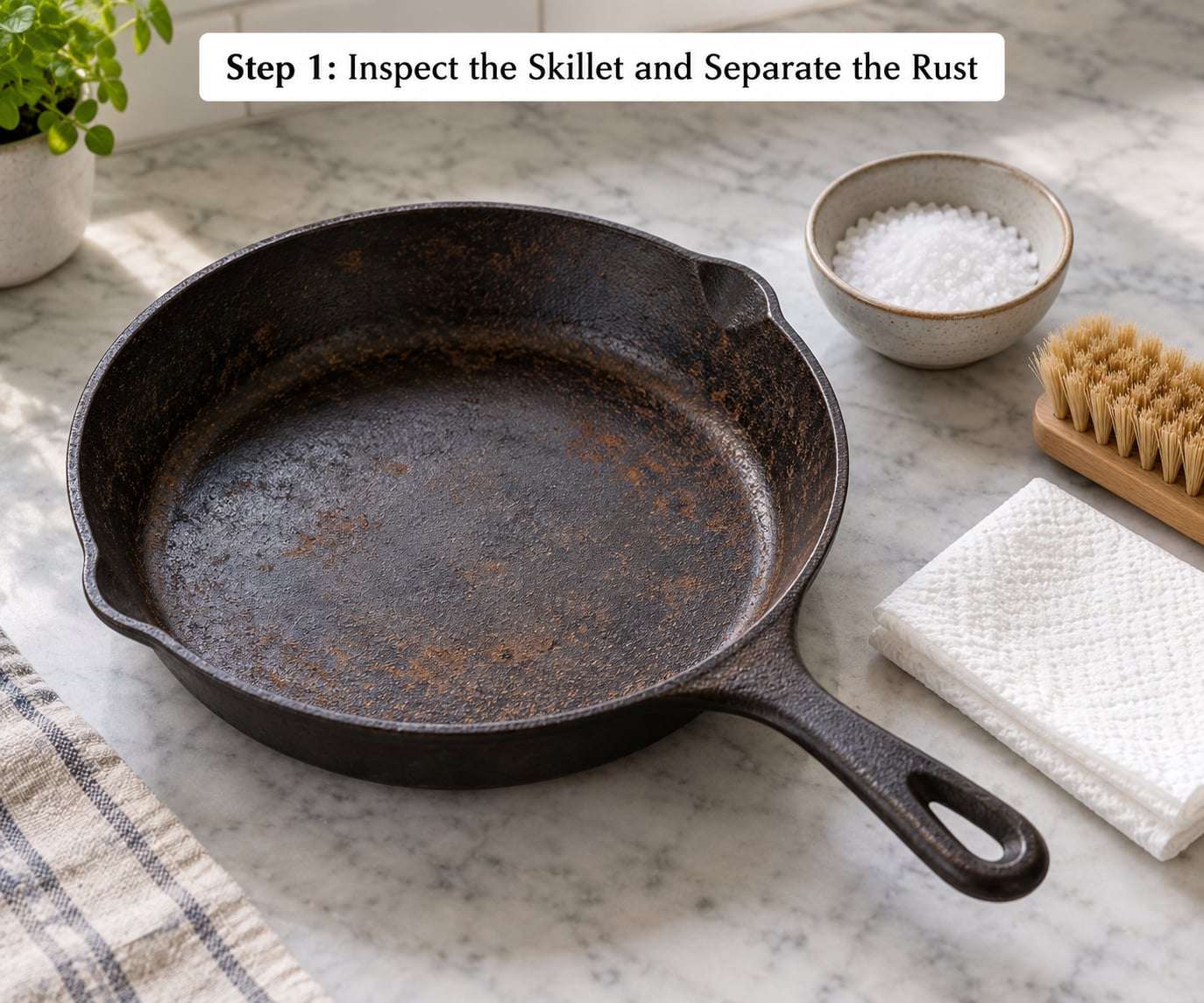
Look at the skillet before you touch it, because the treatment depends on the condition. Orange-brown powdery patches mean loose surface rust that scrubs off easily. Dark flakes that chip away are old seasoning that is separating from the metal. Craters you can feel with a fingernail are pitting, and that changes the plan.
Also note what you want to keep. Seasoning on the walls and bottom that is still firmly attached, smooth, and dark is worth keeping — that is a working non-stick surface, and stripping it costs you two or three oven cycles to rebuild. Rust is the only thing that has to go.
Step 2: Remove Rust with a Gentle Abrasive
Start with the least aggressive method and only escalate if the rust does not move. Dry brushing with a stiff-bristle brush knocks off flaky rust and loose seasoning in a few minutes and costs nothing. Most light rust disappears at this stage.
For rust that clings, make an abrasive paste from coarse salt and a splash of water, then scrub it in circles with a cut potato. The potato’s starch-backed flesh acts as a gentle grinder and the salt does the cutting. A lemon half works the same way, with the added citric acid. Rinse, dry, and check the result before moving on.
Moderate rust benefits from acid. Cover the surface with white vinegar and leave it for 30 to 60 minutes, no longer. Forum consensus on r/castiron and castironforum.com is consistent on this: long soaks etch and dull the iron. Scrub with a non-ferrous sponge or copper mesh while the vinegar is still wet.
Step 3: Wash and Dry the Skillet Thoroughly
Wash with hot water and a squirt of dish soap to remove loose grit and any remaining vinegar film. Scrape out softened stuck food with a pan scraper or a stiff nylon brush rather than steel wool, which will scratch bare metal.
Then dry it properly. Heat it on the stovetop for a few minutes until the water is gone, then wipe with a paper towel, then set it upside down on a warm surface for ten minutes. Enthusiasts on castironforum.com stress this step more than any other because a single bead of trapped moisture starts new rust the same night.
Step 4: Remove Stubborn Rust or Heavy Pitting
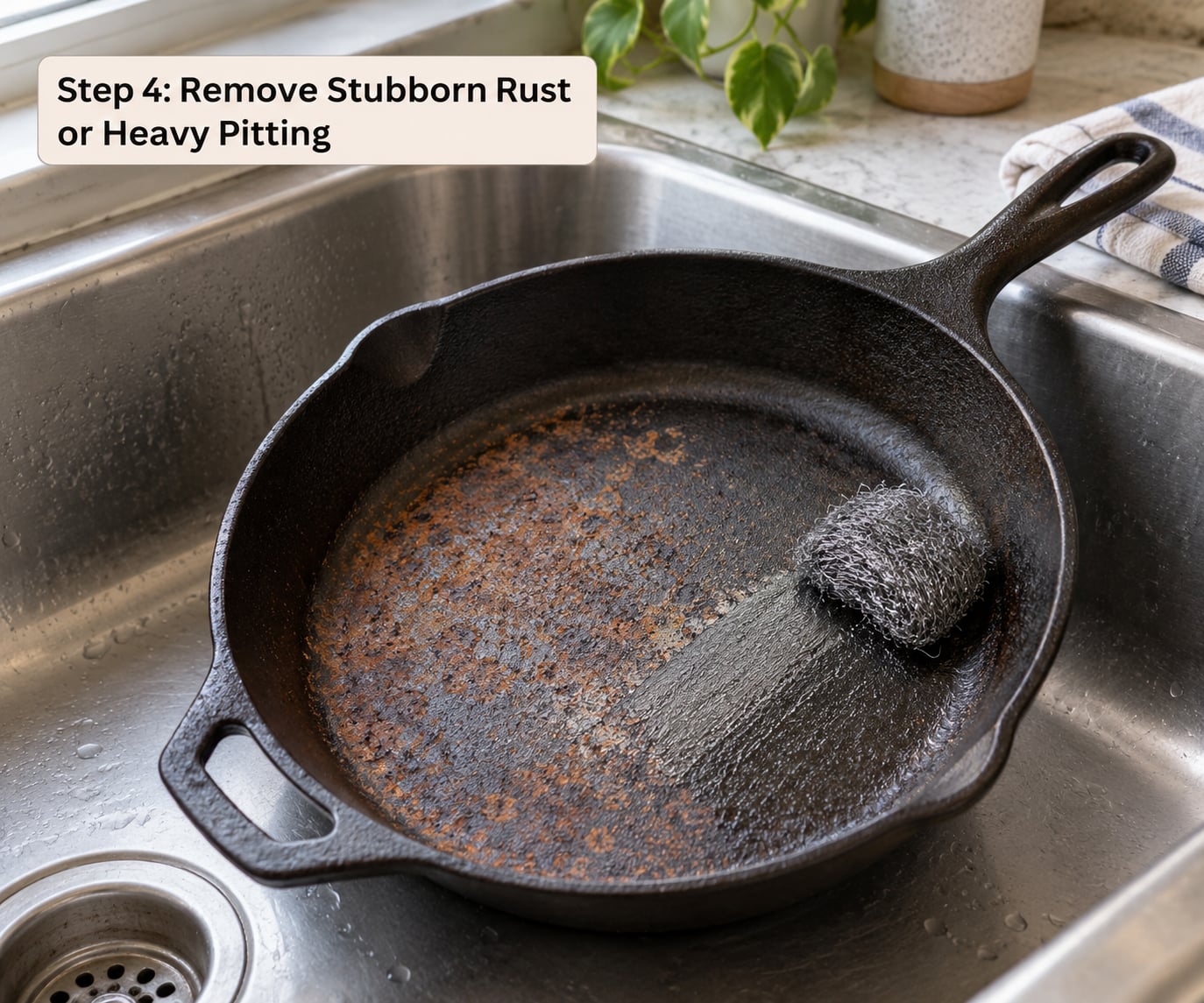
For rust that survived the salt and the vinegar, work with 0000 steel wool. It takes off thin rust without gouging the iron the way a coarse pad does. Scrub the cooking surface, the rim, the handle, and the outer walls, since rust on the exterior is easy to forget and it will spread back inward.
Skip the angle grinder and the wire wheel. They cut into the metal fast, and deep gouges become permanent pits that trap moisture. Avoid lye and oven cleaner too unless you are restoring an antique and you know what you are doing — lye is genuinely dangerous to handle and strips every bit of seasoning in one pass.
Electrolysis is the safe answer for heavy rust on a pan you want to keep intact. A plastic tub, a battery charger, and baking soda in water pull the rust off without touching the iron. The pan comes out cleaner than steel wool can manage, at the cost of a few hours of setup. Ventilate the area because hydrogen gas builds up at the electrode.
Step 5: Season the Clean Skillet
Put the pan upside down in the oven, spread a very thin layer of oil over every surface, and wipe it with a paper towel until the pan looks almost dry. Any oil left standing will polymerize into a gummy film — this is the single most common reason a restored pan feels sticky.
Bake at 450°F for one hour, then cool on the stovetop. Repeat two or three times. Seasoning builds in thin layers, so three light coats beat one thick coat every time. The pan is ready when the surface is dark, even, and slightly satin rather than wet-looking.
Step 6: Check the Result and Start Cooking
Rub a finger across the cooking surface. Rough patches mean bare iron is still exposed and need another coat. Then test it: heat the pan, add a little oil, and cook something fatty like an egg or a strip of bacon. If it slides after a minute, the seasoning is holding.
From here, the habits matter more than the restoration. Wash hot, dry on the heat, wipe a pin-thin layer of oil, and store it uncovered or with a paper towel between stacked pans.
Common Mistakes
Soaking the pan for hours or overnight. Vinegar works in 30 to 60 minutes. Longer soaks etch the iron, dull the surface, and leave a grey cast you have to scrub off later.
Storing or seasoning while damp. Rust that reappears a week later almost always started with a wet pan, not a bad technique. Dry on the stovetop, not just with a towel.
Using too much oil. Thick layers turn gummy and flake. Wipe the pan back until it looks dry; the oil that is left is all the oil you need.
Skipping the oven. Oil that is simply air-dried stays tacky. Seasoning is a heat-driven polymerization process, and baking is what turns oil into a hard coating.
Expecting deep pitting to disappear. Pitting is corrosion that has eaten into the metal. You can season around it and the pan will cook well, but the craters will still be there and they will hold moisture.
Re-seasoning after every scrub. A quick wash with soap does not require a new oven cycle. Only bare, exposed iron needs seasoning.
Frequently Asked Questions
Can vinegar be used to remove rust from cast iron pans?
Yes, and it is the fastest chemical option for moderate rust. Fill the pan with white vinegar so the rusted surface is covered, leave it for 30 to 60 minutes, then scrub with a non-ferrous sponge while the vinegar is still wet. Do not soak for hours or overnight; extended exposure etches the iron and dulls the surface. Rinse and dry immediately, then re-season, because vinegar also strips the seasoning you did not intend to lose.
Can I use Dawn dish soap to clean my cast iron?
Yes. Modern dish soap, including Dawn, is fine for cast iron. The old warning came from soap that left a greasy film, not from cleaning power. Use a small amount with hot water and a brush, rinse well, and dry the pan on the stovetop. What you avoid is leaving the pan wet or letting oily soap residue sit on bare metal, and neither has anything to do with the brand of soap you use.
Is rust on a cast iron skillet dangerous to cook with?
A little surface rust is not a health hazard in the way people fear. Iron oxide does not leach into food in meaningful amounts, and a short bout of scrubbing followed by re-seasoning leaves you with a normal cooking surface. Cook on a rusty pan only if you have no choice, and scrub first. If the rust is deep, flaky, or smells musty, restore the pan properly before using it again.
Why does my cast iron skillet keep rusting after I season it?
Two causes cover almost every case. First, the pan was not fully dry before oiling, and flash rust started during storage. Second, the seasoning layer is thin or patchy, so bare iron is still exposed. Fix both by stripping the pan with steel wool, drying it on the stovetop for several minutes, wiping off all but a film of oil, and baking at 450°F for an hour, two or three times.
How do I stop my cast iron skillet from rusting?
Keep water off the surface for as long as possible and keep oil on it. After cooking, scrape, wash hot with soap, dry on the stovetop, then wipe a very thin coat of oil over the surface. Store the pan uncovered, or with a paper towel between stacked pans, so condensation cannot sit inside. Keep it out of the dishwasher and off damp concrete shelves, and use it regularly — a pan that is used does not have time to rust.
Can a rusty cast iron skillet be restored, or should I replace it?
Almost always restore it. The iron underneath the rust is usually sound, and most rusty pans are cheap secondhand finds or inherited pieces that cook better than anything you would buy new. Replace a pan only if it has a crack running through the base or handle, if the bottom is warped so it rocks on a flat counter, or if pitting is so deep that the surface no longer sits flat. Otherwise, an afternoon of scrubbing brings it back.
Conclusion
Start with the gentlest thing that works: a stiff brush for loose rust, coarse salt and a potato for what clings, vinegar for 30 to 60 minutes for anything moderate, and extra-fine steel wool for the rest. Then dry the pan on the heat until it is hot to the touch, wipe on the thinnest coat of high-smoke-point oil you can manage, and bake at 450°F for an hour, repeating two or three times.
After that, the pan stays in good shape if you dry it on the stovetop after every cook, keep a pin-thin layer of oil on the surface, and store it somewhere dry and uncovered. A rusty skillet is almost never a lost cause, and most of the difference between a pan that rusts again in a month and one that lasts decades comes down to drying.