A pound cake sinks in the middle when the dense center has not cooked through before the cake comes out of the oven. If you know how to make pound cake that does not sink, the work is mostly about heat and time: a full preheat, a pan filled no more than two-thirds, a cool start at 325 degrees F, and a center that hits 210 to 215 degrees F before you pull it.
The good news is that almost every sunken pound cake comes down to one of seven causes, and most of them are the oven or the clock, not the recipe. An hour of mixing and an hour and a half of baking covers a single 10-inch tube pan.
Start with the tools below, then work through the method in order. The order matters more than the ingredient list.
Table of Contents
- What You Need
- Step-by-Step: How to Make Pound Cake That Does Not Sink
- Prepare the Pan and Ingredients for a Cake That Does Not Sink
- Cream the Butter Until Pale and Airy
- Add Eggs Gradually Without Overmixing
- Fold in Flour and Lemon Zest Gently
- Bake Until the Center Is Just Set
- Cool the Cake in the Pan First
- Common Mistakes
- Overmixing the Batter
- Using Cold or Overly Soft Ingredients
- Opening the Oven Too Early
- Baking at the Wrong Temperature
- Unmolding Before the Cake Sets
- Tips for a Consistently High Pound Cake
- Frequently Asked Questions
- Why is my pound cake sinking in the middle?
- Can I still eat a cake that sank in the middle?
- Will a sunken cake rise again?
- What to do with a cake that sank in the middle?
- How do I tell if my cake is overmixed?
- Is my pound cake supposed to crack on top?
- Conclusion
What You Need

A classic pound cake is roughly one part each butter, sugar, eggs, and flour, with very little chemical leavening. That means almost no internal scaffolding, so anything that slows the center from setting shows up as a collapsed dome.
Ingredients
- 1 cup unsalted butter (2 sticks), softened to room temperature but still firm
- 1 cup granulated sugar
- 4 large eggs, at room temperature
- 2 cups all-purpose flour, weighed if you own a scale
- 1/4 cup sour cream or buttermilk
- 1 teaspoon pure vanilla extract
- 1 teaspoon finely grated lemon zest
- 1/2 teaspoon baking powder (optional; traditional pound cakes rise without it)
- 1/4 teaspoon fine salt
Equipment that actually changes the outcome
- An oven thermometer. A dial that reads 350 does not mean the oven is 350.
- An instant-read thermometer for the center of the cake.
- A cake tester or long skewer for the crevices a thermometer will not reach.
- A 10-inch tube pan, Bundt pan, or two 8-inch loaf pans. Smaller holiday Bundt pans are a common cause of overflow.
- A wire cooling rack and a thin spatula for unmolding.
Preparation choices
Bring the butter, eggs, and sour cream to room temperature about an hour ahead, and preheat a full 20 to 30 minutes. Room temperature butter creams; straight-from-the-fridge butter just sits in the sugar and leaves grit behind.
Step-by-Step: How to Make Pound Cake That Does Not Sink
Prepare the Pan and Ingredients for a Cake That Does Not Sink
Grease the pan and dust it with flour, or coat it with a flour-based pan spray, then wipe out the excess with a paper towel. Too much leftover flour pastes itself into the crust and makes the sides pull away instead of rising with the batter.
Weigh the flour if you can. If you are spooning it in, stir it with a spoon several times to break up clumps and aerate it, then level it rather than packing it. Packed flour adds weight to a batter that has no leavening to spare, and a heavy batter settles into the bottom of the pan and bakes dense.
Cream the Butter Until Pale and Airy
Beat the softened butter and sugar together for a full 3 to 5 minutes on medium speed. Stop the mixer and scrape the bowl twice, because the sugar hides in the butter at the bottom and never gets creamed.
You are looking for a mixture that is noticeably paler, fluffy, and slightly expanded in volume, with no sandy grit on the paddle. Old pound cake recipes call for an hour of beating, and following that advice is one of the fastest ways to work the air out of a modern stand mixer batter. Three to five minutes is enough.
Add Eggs Gradually Without Overmixing
Add the eggs one at a time on low speed, and let each one disappear into the batter before the next goes in. A pound cake batter holding four to five eggs plus nearly a cup of sugar is heavy, and it will look slightly curdled for a minute. That is fine.
Turn the mixer off the moment the last egg is in, scrape the bowl, and move straight to the dry ingredients. If the eggs go in all at once on high speed, the butter and sugar clump into small curds, the aeration drops, and the loaf loses the lift it needs to hold itself up.
Fold in Flour and Lemon Zest Gently
Sift or aerate the flour, then add it in three or four additions along with the sour cream, alternating dry and wet and ending with flour. Switch to a spatula and fold with a light hand until no dry streaks remain, about 30 seconds of actual folding.
Stop the moment it comes together. Flour that gets beaten develops gluten, and gluten plus a dense butter batter plus a long bake equals a tight, heavy loaf that pulls down from the middle as it cools. The lemon zest goes in with the dry ingredients and adds lift of its own.
Scrape the batter into the prepared pan and smooth the top. Fill the pan no more than two-thirds of the way up, and smooth the surface with the back of a spoon so the heat reaches the center evenly.
Bake Until the Center Is Just Set
There are two reliable ways to run a pound cake, and both work if you trust your thermometer. This is the step where most attempts at how to make pound cake that does not sink either succeed or fail, because the center temperature is the only number that cannot be argued with.
Cold start (my preference for a tall loaf): set the pan in a cold oven, set the dial to 325 degrees F, bake one hour, then raise it to 350 degrees F and bake another 30 to 45 minutes. The gentle first hour lets the dense center set before the crust firms up around it, which is exactly the moment a pound cake collapses.
Full preheat: bring the oven to 325 or 350 degrees F and hold it there 20 to 30 minutes, then bake 75 to 105 minutes depending on the pan.
Test the center with an instant-read thermometer. The cake is done at 210 to 215 degrees F. Push a cake tester or skewer into the deepest crevice; it should come out clean or with a few moist crumbs, never wet batter. The edges will have started to pull from the pan and the top will be evenly browned.
Do not open the door for the first 45 to 60 minutes. A swing of cold air into a partially set pound cake is enough to make the middle fall before you even get the pan open.
Cool the Cake in the Pan First
Let the cake sit in the pan for 10 to 15 minutes. Run a thin knife around the edge to release the sides, then turn it out onto a wire rack. If you bake in a tube or Bundt pan, invert the pan over the rack, lift off the pan, and let the cake finish cooling upright.
The cake is still fragile when it leaves the oven. Pulling it out while hot bends the middle, and the bend becomes a dip. Ten minutes of pan time is the difference between a domed loaf and one that sets with a soft spot.
Common Mistakes
The three failure modes bakers name most often on the baking forums are a cake that falls, a cake that is still raw in the middle, and a cake that never forms a crackly top. Here is what sits behind each one.
Overmixing the Batter
Overmixing shows up as a cracked top with a raw seam running under the crack, and as a crumb that is tight and chewy rather than fine and tender. It also happens more often than people expect, because old recipes call for an hour of beating.
Fix it by creaming 3 to 5 minutes, adding eggs one at a time on low, and folding the flour with a spatula instead of the mixer. Then get the batter into the oven quickly, because batter that sits while you scrape bowls is also losing lift.
Using Cold or Overly Soft Ingredients
Cold butter and cold eggs do not emulsify into the sugar properly, so you get a heavier batter with less air. Butter melted to liquid loses the structure entirely, which is a different problem, a greasy one, and it is not what sinking looks like.
Fix it by bringing the butter, eggs, and sour cream to room temperature for about an hour. The butter should dent under your thumb but still hold its shape. Cold milk and cold eggs are the usual culprit in summer kitchens.
Opening the Oven Too Early
Every opening before the center has set is a risk. Early bakers often open the door to rotate the pan or to test with a toothpick, and the temperature swing plus the air movement can make a fragile structure give way.
Fix it by baking uninterrupted for the first 45 to 60 minutes, then testing with a thermometer instead of guessing with the door propped open. If your pan bakes unevenly, rotate it once, after 45 minutes, in a single quick motion.
Baking at the Wrong Temperature
An oven that runs cool is the most common cause of a low dome and a fine, dense crumb. An oven that runs hot sets the crust and the edges within 25 minutes, so the center is still liquid when the timer says the time is up.
Fix it by hanging an oven thermometer on an inside rack for an hour and reading the difference from the dial. If your oven runs 25 degrees cool, set the dial 25 degrees higher. If it runs hot, drop the temperature and give the cake more time, not less. Many home bakers find 15 to 25 degrees of drift and correct for it permanently.
Unmolding Before the Cake Sets
A pound cake that looks done in the oven can still be delicate on the rack, especially near the middle. Pulling it out hot bends it, and the bend shows up as a dip once it cools.
Fix it with a full 10 to 15 minutes in the pan before you touch the edges. If you are in a rush, leave it longer rather than shorter.
Tips for a Consistently High Pound Cake
Weigh your flour. A scale takes the guesswork out of the single measurement that matters most in a leavening-free cake.
Check the pan size before you pour. A 10-inch tube pan holds a classic pound cake. Anything smaller, including many decorative Bundt pans, will overflow or bake the batter up and over the sides with a raw seam underneath.
Test your baking powder if you use it. Put a teaspoon in a cup of hot water; it should foam vigorously right away. Traditional pound cakes rise from steam and air alone, so do not assume the leavening is the reason your cake fell.
Use parchment. A parchment round in the bottom of the pan makes a sunken cake easier to rescue, because you can lift it out in one piece instead of scraping it loose.
Above 3,000 feet, lower the temperature. At altitude, water boils below 212 degrees F, so a pound cake needs 15 to 25 degrees less heat and about 10 to 20 minutes more time, and it will rise faster and set sooner. The center sets sooner, so the same underbake problem shows up at a shorter time.
Store it wrapped. Pound cake keeps for several days at room temperature wrapped tightly in plastic or foil, and it freezes well for months. A wrapped cake never dries out enough to shrink and look sunken.
If it sank, use it anyway. Trim the crater level with a serrated knife, glaze it, or cut it into slices for French toast and bread pudding. A cake that is fully baked through but dipped in the middle is perfectly good to eat. A gummy or doughy center is a different story, and that one goes in the bin. If the center is raw, do not taste-test it, and do not try to bake it again to fix it.
Frequently Asked Questions
Why is my pound cake sinking in the middle?
A pound cake sinks because the dense butter-and-egg center has not set before the cake leaves the oven, so it collapses under its own weight as it cools. The usual triggers are an underbaked center, an oven running cool, a pan filled more than two-thirds, a door opened in the first hour, or a batter that sat too long after the flour went in. Check the center with an instant-read thermometer at 210 to 215 degrees F before you pull the pan.
Can I still eat a cake that sank in the middle?
Yes, if the crumb is set and cooked all the way through. A sunken pound cake is a structural problem, not a safety problem, and the flavor and texture are usually fine once you trim the dip. Trim the crater level, glaze the top, or slice the loaf for French toast and bread pudding. If the center is raw, doughy, or gummy, discard it instead. A sunken top and a raw center are two different failures.
Will a sunken cake rise again?
No. Once the structure has collapsed as the cake cooled, there is nothing to push it back up, and putting it back in the oven only dries it out. What you can do is hide the dip. Trim the top flat with a serrated knife, pour a glaze or icing over it, cut it crosswise so the dip is at the edge of the slice, or repurpose the loaf. A shallow dip in an otherwise good crumb is mostly cosmetic.
What to do with a cake that sank in the middle?
First confirm the center is baked, using a thermometer at 210 to 215 degrees F or a tester that comes out clean. Then trim the sunken area level with the rest of the top and use the crumbs as a bonus. Glaze the cake while it is barely warm so the glaze fills the dip, or turn it into pound cake bread pudding, French toast, or trifle. Do not try to rebake it, and discard it if the center is raw.
How do I tell if my cake is overmixed?
Overmixed cake has a tight, dense, slightly chewy crumb and often a top that cracked with a raw seam running underneath the crack. The dough will have been worked after the flour went in, usually on high speed or with a long creaming time from an old recipe. Watch the flour stage instead of guessing: it should take about 30 seconds of light folding to disappear, and if the batter turns pasty and tight you have gone too far.
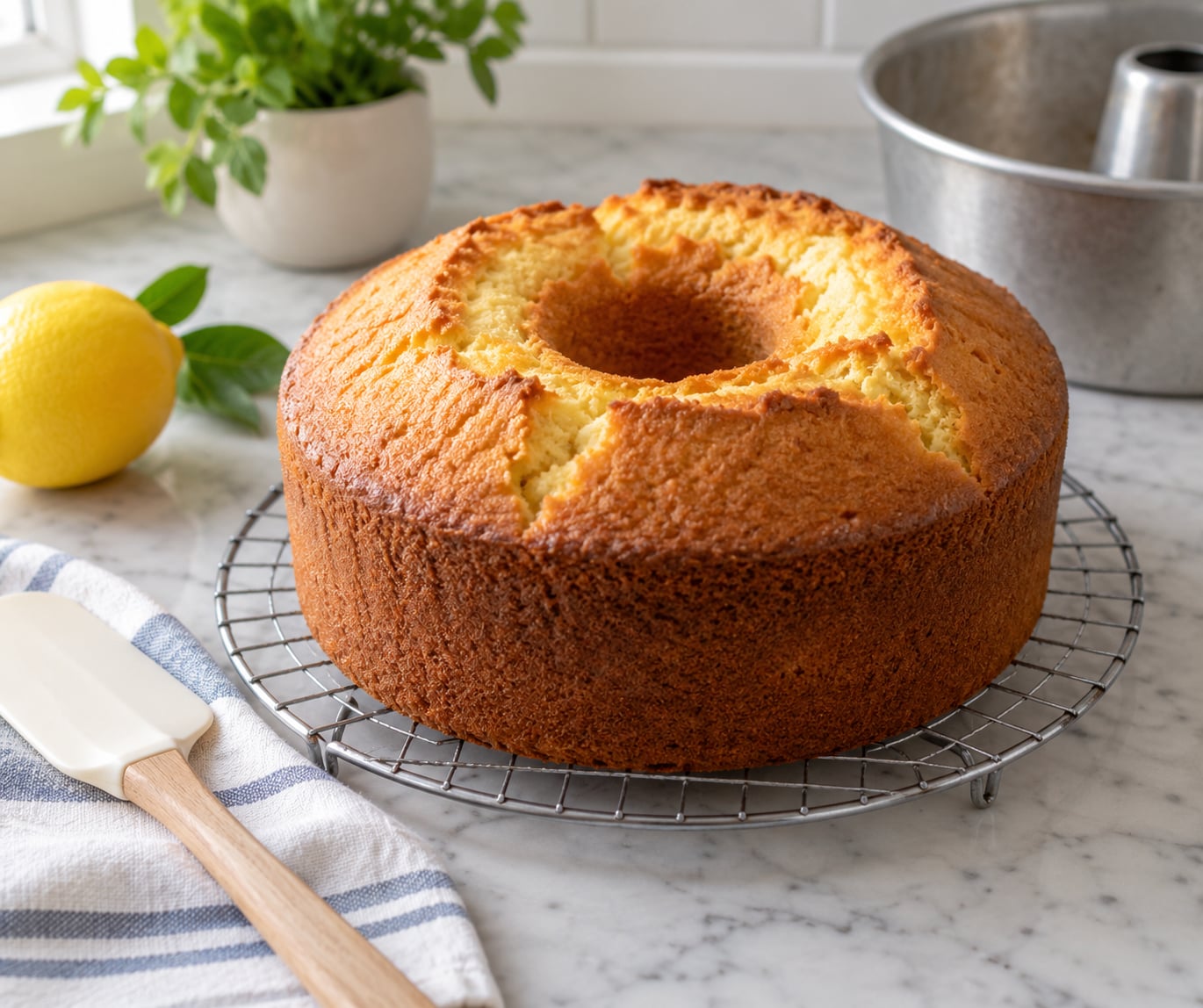
Is my pound cake supposed to crack on top?
A long crack along the top is normal and traditional, especially with a leavening-free pound cake, because the top sets first and splits as the center finishes rising. The crack itself is not the problem. The problem is a loose split with a raw or gummy seam underneath it, which points to a batter that was overmixed or a center that was underbaked. Check the center temperature before you assume the crack ruined the loaf.
Conclusion
Start with the two checks that fix most sunken pound cakes: weigh your flour, and put an oven thermometer in your oven. Then cream the butter and sugar for 3 to 5 minutes, add the eggs one at a time, fold the flour in gently, fill the pan two-thirds, and start cool at 325 degrees F if you want a high dome.
If you only change one habit this week, make it the thermometer. Knowing the center temperature is what turns how to make pound cake that does not sink from guesswork into a repeatable method. Bake until the center reads 210 to 215 degrees F, leave the door shut for the first hour, and cool the cake in the pan for 10 to 15 minutes.