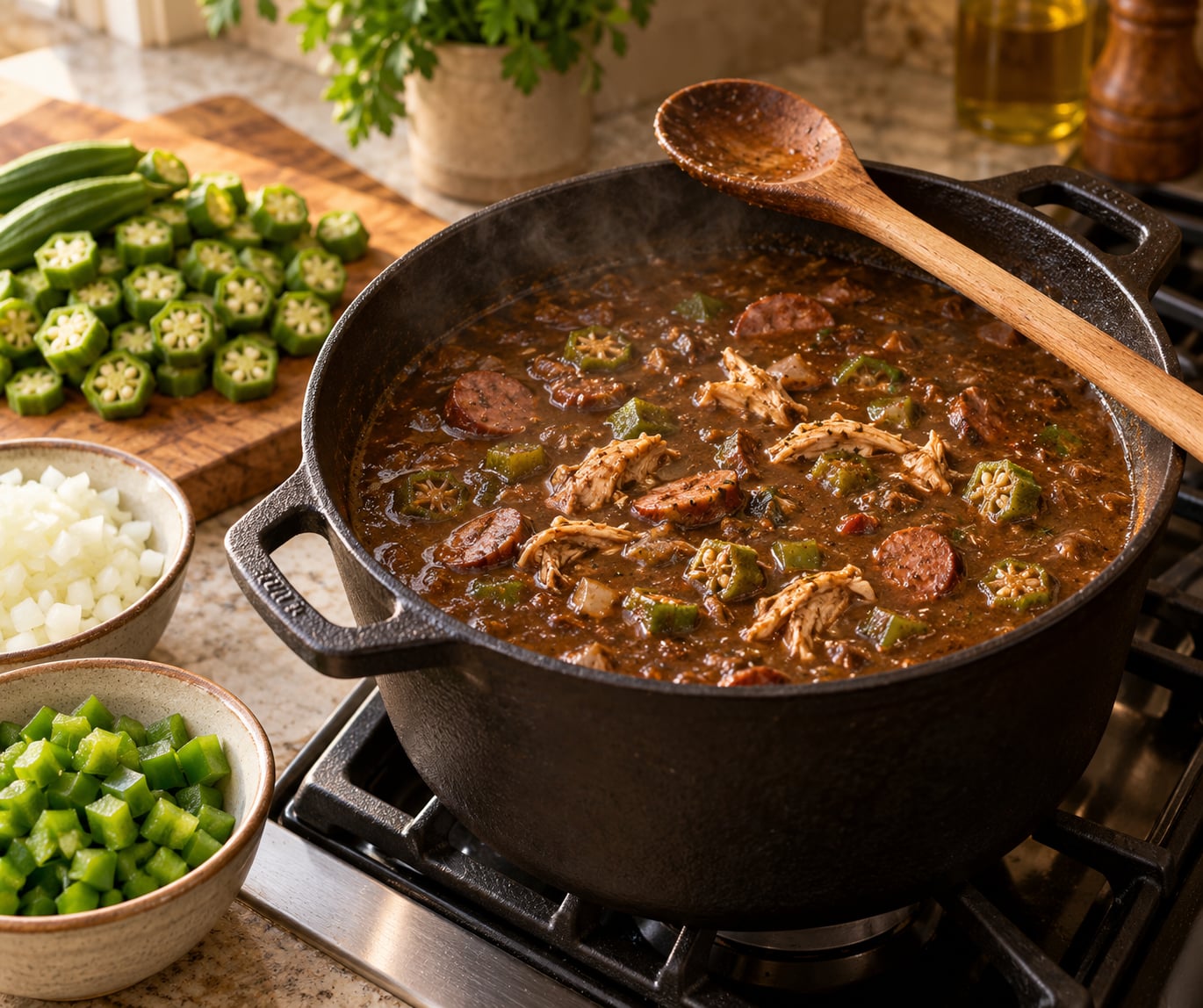
Gumbo with okra comes down to three things: cook the okra first so its slime turns into body, take the roux dark without burning it, and simmer everything gently. If you follow those steps, learning how to make gumbo with okra stops being guesswork.
Most disappointing gumbo is thin, bland, or both, and neither problem comes from the pot. It comes from okra added raw at the wrong moment and a roux stopped at peanut-butter color. Fix those two points and you get a stew that coats the back of a spoon and tastes nutty long before the okra goes in.
Worth knowing why the dish works this way. Sliced okra releases a clear gel called mucilage when it is cut and heated. That gel is a natural thickener, and it is why the word gumbo comes from a West African word for okra. The earliest versions of this dish had no flour at all. Roux is the Louisiana addition, and filé powder, made from dried ground sassafras leaves, is the third option. Most cooks use two of the three.
Okra’s place is argued over even inside Louisiana. In some areas it is entirely optional, and in much of New Orleans it gets left out of gumbo altogether. Cook it anyway. It is the original thickener, it costs almost nothing, and it is what makes this pot worth making.
This recipe serves six to eight and takes about four hours, most of it unattended stirring and simmering. Total hands-on time is closer to an hour.
Table of Contents
- What You Need
- Ingredients
- How much okra you need
- Optional equipment
- Step-by-Step
- Choose and Prepare the Okra and Vegetables
- Cook the Okra and Soften the Vegetables
- Brown the Meat for Flavor
- Make a Dark Roux Without Burning It
- Build the Broth and Simmer
- Adjust the Consistency and Serve
- Common Mistakes
- Frequently Asked Questions
- Can I use frozen okra when making gumbo?
- How do I keep gumbo from tasting bitter?
- How can I make gumbo thicker or thinner?
- Can I make gumbo with okra ahead of time?
- How long does gumbo with okra keep in the refrigerator?
- What should I serve with gumbo made with okra?
- Conclusion
What You Need
The ingredient amounts below fill a heavy 8-quart Dutch oven or pot with a lid. There is no good substitute for a pot that holds heat evenly and has a lid, because the roux stage needs an even burner and the simmer needs a tight cover.
Ingredients
- 1 to 1.5 pounds fresh okra pods, or 2 to 3 cups sliced frozen okra
- 1 pound andouille sausage, sliced into half-inch rounds (tasso ham works in its place)
- 1.5 pounds boneless chicken thighs
- 1 large yellow onion, diced
- 1 green bell pepper, diced
- 3 celery stalks, diced
- 4 cloves garlic, minced
- 6 cups chicken broth
- 1/2 cup neutral oil or peanut oil
- 1 cup all-purpose flour
- 2 bay leaves
- 1 teaspoon thyme
- 1 tablespoon Cajun seasoning
- Salt and black pepper to taste
- Hot sauce and parsley for serving
The onion, bell pepper and celery are the holy trinity, the Cajun and Creole aromatic base that every serious gumbo starts with. Dice all three the same size so they soften at the same rate.
How much okra you need
Okra quantity is the number home cooks ask about most, and the honest answer is a range. Use the table below as your guide.
| Pot size | Sliced okra | Whole okra pods | Chicken broth | Result |
|---|---|---|---|---|
| 4-quart pot | 1 to 1.5 cups | About 3/4 pound | 4 cups | Thick, almost a stew |
| 6-quart pot | 2 cups | About 1 pound | 5 cups | Classic body |
| 8-quart pot | 2.5 to 3 cups | 1 to 1.5 pounds | 6 cups | Spoon-coating consistency |
| 12-quart party pot | 4 to 5 cups | 2.5 pounds | 10 cups | Serves 14 to 16 |
The trap is going over. Too much okra plus a full cup of roux turns gumbo into something closer to thick green stew that barely pours. If you like that texture, good, but scale the okra down before scaling the roux up.
Optional equipment
- A wooden spoon, which handles hot roux better than metal and is worth owning for this alone
- A large cutting board and a sharp knife
- An oven-safe thermometer, only if you are cooking chicken pieces rather than boneless thighs
- A separate skillet for frying okra, ideally cast iron or heavy steel
Substitutions are easy here. Filé powder can stand in for part of the okra, dusted over each bowl at the table. Tasso ham replaces andouille with a smokier, leaner result. And okra can be omitted entirely for a plain roux-thickened gumbo, which is what many New Orleans cooks prefer.
Step-by-Step
Choose and Prepare the Okra and Vegetables
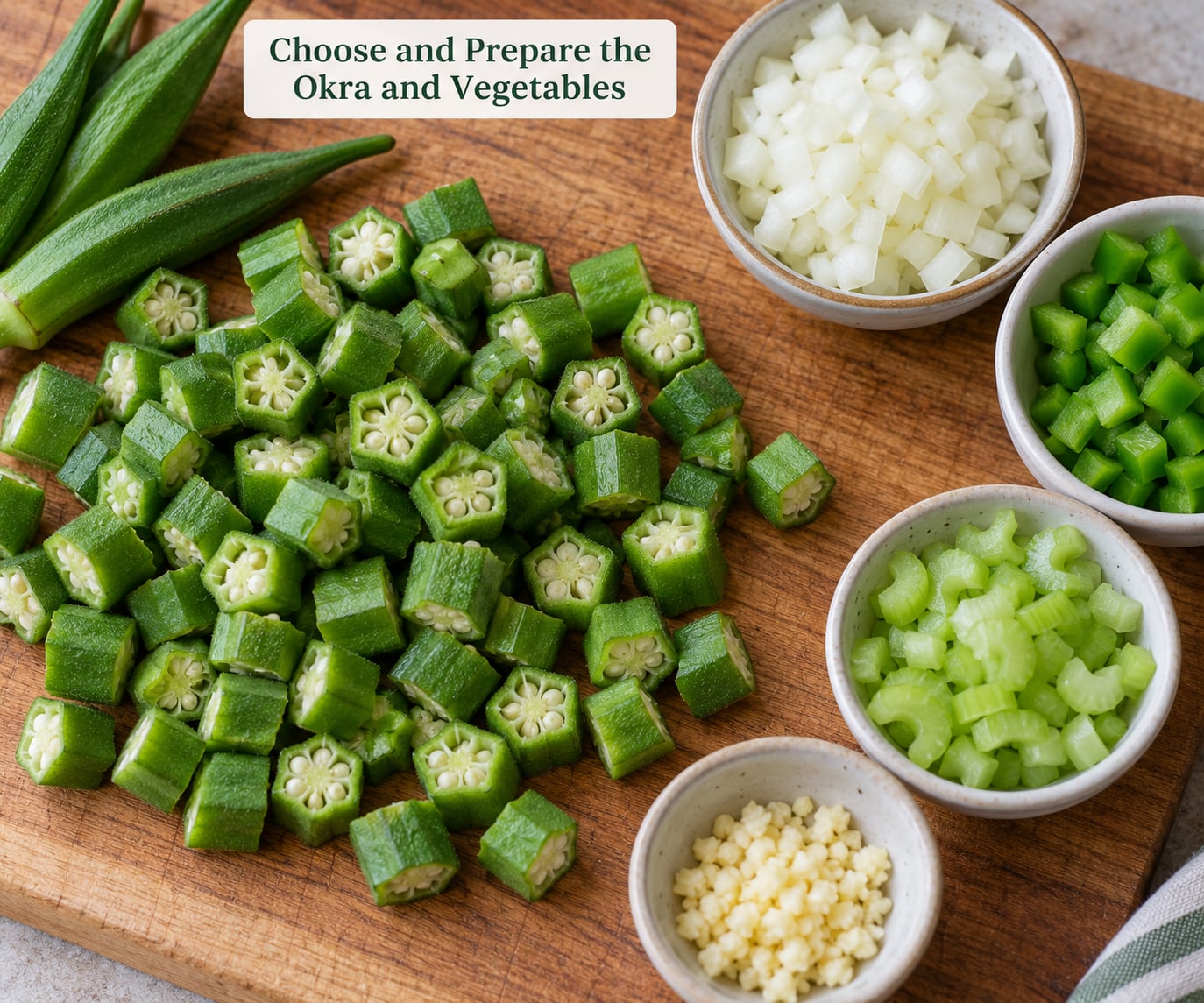
Rinse the okra under cold water and dry it well. Water on the pods dilutes the frying and makes the slices steam instead of sear. Look for bright green, firm pods; the very tall ones have been sitting too long and tend to be fibrous.
Trim the stem end and slice crosswise into even half-inch rounds. Even cuts matter more than size here. Overcut the okra and it disperses into the pot in a fine, gritty cloud rather than staying in recognizable pieces, which is the single most common complaint about okra gumbo. A pound of okra should give you two full cups of slices.
Dice the onion, bell pepper and celery while you are at it, mince the garlic, and set them aside in one bowl. Keeping the trinity together matters later, because one cook’s trick for saving a darkening roux is dumping the cold chopped vegetables straight into the pot to drop the temperature.
Frozen okra works, and it works well. Add it frozen with no thawing and give it about five extra minutes of cooking. Fresh okra added raw usually needs 20 minutes of cooking before its slime turns into body; frozen okra is already partly cooked, so 25 minutes in the pot is plenty.
Cook the Okra and Soften the Vegetables
Heat a tablespoon of oil in a heavy skillet over medium-high heat. Add the okra in one layer and leave it alone for a minute before stirring. Let the first side take on a little color, then toss and cook another 8 to 10 minutes until the outside looks browned and slightly collapsed and the release of slime has visibly slowed.
That pause is the entire point of pre-frying. Cooking the okra before it meets liquid drives off excess mucilage and concentrates the flavor. Skip it and the slime spreads through the pot instead of thickening it. This is the technique that answers the question cooks ask most, and why a heavy skillet matters more than a nice one.
Do not walk away from this step, and do not overcook it. Once the slices look browned and softened but still hold their shape, they are done. Push them to a plate.
In the same skillet, soften the onion, bell pepper and celery in another tablespoon of oil over medium heat for 8 to 10 minutes, until the onion is translucent and sweet and the peppers have lost their crunch. Add the garlic for the final minute only. Burning garlic is the fastest way to make a whole pot taste harsh.
Brown the Meat for Flavor
Season the chicken thighs with salt and pepper and brown them in batches in the Dutch oven with a little oil. Give each batch room. Crowding the pot drops the temperature, the meat sweats instead of sears, and you get pale steamed chicken with no fond on the bottom, which is where a good portion of the gumbo flavor actually lives.
Cook until the underside is deeply golden, about 5 to 6 minutes per side. Sear the andouille slices in the same pot after the chicken comes out, cooking until the casing splits and the fat renders, roughly 4 minutes. The rendered sausage fat is what gives okra gumbo its backbone.
If you are using bone-in chicken or whole cuts instead, they must reach 165°F (74°C) as measured in the thickest part, away from the bone, before they go into the simmer. Boneless thighs only need to be browned; their time in the broth finishes them.
There is a shortcut worth knowing: brown the chicken and sausage in the oven instead, until the edges crisp, then use all that rendered fat to make your roux. You get the same fond and the same fat without standing at the stove.
Make a Dark Roux Without Burning It
Pour off the excess fat, leaving about half a cup in the pot, or add fresh oil to reach half a cup. Add the flour and whisk it into the fat until every dry patch is gone and the mixture is smooth. This is the moment to do the whisking, because once you start cooking, only a wooden spoon works.
Stir constantly and steadily. Not fast, not slow, just nonstop. Keep the heat on medium and expect 30 to 45 minutes. Track the color rather than the clock.
| Color | Time | What it tastes like | What to do next |
|---|---|---|---|
| Blond | 5 to 8 minutes | Raw flour, faintly sweet | Keep cooking, this is only a starting point |
| Peanut butter | 15 minutes | Toasty, mild | Still too light for Louisiana okra gumbo |
| Chestnut | 22 minutes | Deeply nutty | Acceptable for a Creole-style gumbo with tomato |
| Mahogany | 30 minutes | Roasted, almost chocolate | The right target for Cajun okra gumbo |
| Dark chocolate | 40 to 45 minutes | Intense, near-bitter edge | The classic New Orleans target, still fine here |
| Black | Past 45 minutes | Burnt, acrid | Start over; it cannot be rescued |
Two things go wrong here and both are fixable. If the roux breaks into dry clumps, lower the heat and keep stirring; the fat reabsorbs as the flour hydrates and the paste comes back together. If oil pools on the surface because the roux is cooked past what the flour can hold, skim the excess off with a spoon before you add liquid.
If you smell scorch, take the pot off the heat immediately. A burnt roux cannot be fixed by adding stock. Pour it out, scrub the pot, and start again. This is the single biggest intimidation in the whole dish and the one mistake people most want to avoid, so treat the color table above as your reference and keep the flame no higher than medium.
Never pour liquid into hot grease or loose flour directly. Add the trinity first and stir until the onions soften, about 5 minutes, which cools the pan and gives you a chance to judge the color without the pot screaming.
Build the Broth and Simmer
Return the browned chicken and sausage to the pot. Pour in the chicken broth a cup at a time, stirring after each addition so the roux loosens into the liquid rather than hitting it in clumps. Scrape the bottom of the pot to loosen the fond as you go, because that browned layer is flavor you cannot buy in a bottle.
Add the bay leaves, thyme, Cajun seasoning, the pre-fried okra and the garlic. Bring the pot up to a bare simmer, then drop the heat until you see a bubble every second or two and the surface barely moves.
Gumbo should never boil hard. A rolling boil scatters the fat, breaks the emulsion that makes the sauce look glossy, and stirs sediment up from the bottom. Cover and simmer for 60 to 90 minutes, stirring occasionally and checking the bottom for sticking.
As it cooks, the roux and the vegetables thicken the broth while the okra mucilage adds extra body without any starch at all. If the bottom starts to catch, use a wooden spoon to lift and swirl rather than scrape, and if necessary give the pot a thirty-second lift off the burner.
If you want seafood, stir in shrimp or crab during the final 10 to 15 minutes. Any longer and the shrimp go rubbery and the crabmeat turns grainy.
Adjust the Consistency and Serve
Taste for thickness once the simmer is done. Dip a spoon in and hold it up: a good okra gumbo coats the back of the spoon and runs off slowly in a thick sheet. If it runs thin, stir in hot broth a quarter cup at a time and give it two minutes between additions.
For thicker gumbo, leave the lid off and simmer uncovered for 10 to 20 more minutes. Filé powder is the other lever, stirred in off the heat a teaspoon at a time. Be careful with it, since it thickens more as it sits and it adds a distinct grassy sassafras note that some people love and some find overpowering.
Season to taste with salt and pepper, pull out the bay leaves, and ladle over hot white rice. Add parsley, sliced green onion, hot sauce, and more filé powder at the table. A squeeze of lemon or a splash of vinegar right before eating takes the edge off any remaining perceived sliminess, and it is the one kitchen habit here that has spread mostly through social media rather than tradition.
Gumbo thickens as it cools, so day-old batches are noticeably more bodied than the pot you just finished.
Common Mistakes
Bitter or muddy roux. You went past dark chocolate, or you added liquid to very hot grease and the flour fried before it could disperse. Watch the color, keep the heat at medium, and cool the pot with the holy trinity before any liquid goes in.
Slimy, gummy okra. Raw okra added at the start and cooked for a full hour releases its mucilage steadily with nothing to stop it. Pre-fry it for 8 to 10 minutes, add it for the last 20 to 30 minutes of the simmer, and the same okra becomes a thickener instead of a glue.
Watery gumbo. Almost always a light roux, too much broth, or a hard boil. Take it to mahogany, add broth a little at a time rather than all at once, and keep the simmer gentle.
Bland seasoning. Salt in layers, not once at the end. Season the meat when you brown it, the broth when you build it, and taste again at the finish. A full teaspoon of Cajun seasoning per pot is a starting point, not a ceiling.
Greasy film on top. The roux held more fat than it could absorb. Skim the surface with a spoon before serving, and add a tablespoon of cold broth to emulsify what remains.
Tough meat. Large chunks need longer than small ones, and a hard boil tightens them instead of tenderizing them. Cut the chicken into bite-size pieces for the short simmer, or use 165°F as your target for anything bone-in and give it the full 90 minutes.
Sticking and scorching. A wide pot, a wooden spoon, and a low flame. Stir every ten minutes, and if fond is browning fast on the bottom, drop the heat rather than adding more liquid, which washes out the flavor you are trying to build.
Two habits that fix more problems than any recipe tweak. Measure your flour and oil with the same measuring cup, never scoop, because a loosely filled flour cup is the most common reason a gumbo will not thicken as expected. And taste the pot at twenty-minute intervals after the first hour, since seasoning and thickness both shift during a long simmer.
Reheating works best on the stove with a splash of broth, over medium heat, until it just comes to a simmer. Microwaving in uneven bursts tends to make the roux separate slightly and leaves you with hot spots that keep cooking the bottom.
For a party, make the gumbo a day ahead and hold it in the refrigerator. Reheat the whole pot slowly the next day, adding broth as needed, so you are not standing over a roux while guests arrive.
Frequently Asked Questions
Can I use frozen okra when making gumbo?
Yes, and you do not need to thaw it first. Add frozen sliced okra straight into the pot and give it about five extra minutes compared with fresh okra, roughly 25 to 30 minutes in the simmer. Frozen okra is partly cooked already, so it releases its mucilage faster. Pre-frying it takes slightly longer than fresh slices because of the extra moisture, but the same browning rules apply.
How do I keep gumbo from tasting bitter?
Bitter gumbo almost always means a scorched roux rather than too much spice. Once flour passes dark chocolate and starts smoking, the flavor cannot be pulled back out, so pull the pot off the heat and start again. Keep the flame at medium, stir nonstop, and use the color ladder as your guide rather than the clock. Adding a lot of hot broth does not fix burnt flavor.
How can I make gumbo thicker or thinner?
For thicker gumbo, leave the lid off and simmer uncovered for 10 to 20 minutes so excess liquid cooks off, or stir in teaspoonfuls of file powder off the heat. For thinner, add hot chicken broth a quarter cup at a time and wait two minutes between additions. Remember that okra gumbo thickens noticeably as it cools, so make it slightly thinner than you want it to be at the table.
Can I make gumbo with okra ahead of time?
Yes, and most cooks prefer it. Gumbo made a day in advance tastes better because the seasoning has time to settle into the meat and the okra mucilage gives the broth more body overnight. Cool it uncovered until room temperature, then refrigerate covered for up to five days. Reheat slowly on the stove with a splash of broth, stirring, until it just returns to a simmer.
How long does gumbo with okra keep in the refrigerator?
Refrigerated gumbo keeps well for up to five days when stored in a sealed container and cooled promptly. Freeze it in portioned containers for two to three months and thaw overnight in the refrigerator rather than on the counter. Okra-based gumbo freezes well because the mucilage thickens as it chills. If it seems too thick after thawing, loosen it with a little hot broth while reheating.
What should I serve with gumbo made with okra?
Cooked long-grain white rice is the classic answer, since rice absorbs the broth without competing with the okra flavor. Potato salad, sweet pickles, sliced green onion and parsley, and a bottle of hot sauce on the table are the usual side dishes at a gumbo table. A small salad and cornbread also work. For a larger meal, serve okra gumbo with cornbread or French bread alongside the rice.
Conclusion
Start by prepping the okra and everything else, then give the roux the time it needs. Those two steps decide whether the pot turns out right.
Keep four control points in mind the whole way through: a mahogany to dark chocolate roux that smells nutty and never smokes, enough chicken broth that you can loosen the result later, a simmer gentle enough to keep the emulsion intact, and a taste and thickness check before you ladle a single bowl. Everything else in how to make gumbo with okra is a variation on those four.