What is the soft ball stage in candy making? It is the point where a boiling sugar syrup reaches 235-240°F (112-116°C), roughly 85% sugar, so a small drop cooled in cold water forms a soft, flexible ball that flattens when you pick it up. That test, not the clock, tells you the syrup is ready for fudge, fondant, or pralines.
Everything below assumes you work with dry hands, a clipped-on candy thermometer, and a cup of cold water parked within arm’s reach of the stove. Molten sugar sticks to skin and causes serious burns, so this is not a recipe to rush.
Last updated October 2026 by the Sweet Auburn Curb Market kitchen team.
Table of Contents
- What Is the Soft Ball Stage in Candy Making? at a Glance
- What Does the Soft Ball Stage Mean?
- How Do You Recognize the Soft Ball Stage?
- What the soft ball stage in candy making looks like in the pan
- What to do when the test disagrees with the thermometer
- How Do You Reach the Soft Ball Stage?
- What Temperature Is a Soft Ball Candy?
- What Is the Soft Ball Stage Used to Make?
- Why Does My Candy Miss the Soft Ball Stage?
- The fudge set up too soft
- The fudge is rock hard
- The fudge is grainy
- The cold water test felt wrong
- The timing is confusing
- How Do You Keep Candy Soft After Cooking?
- Frequently Asked Questions
- What temperature is the soft ball stage in Fahrenheit?
- Is the soft ball test done in cold or boiling water?
- Can I use a regular kitchen thermometer for candy?
- How do I fix candy that went past the soft ball stage?
- Does humidity change the soft ball candy temperature?
- What to Do First
What Is the Soft Ball Stage in Candy Making? at a Glance
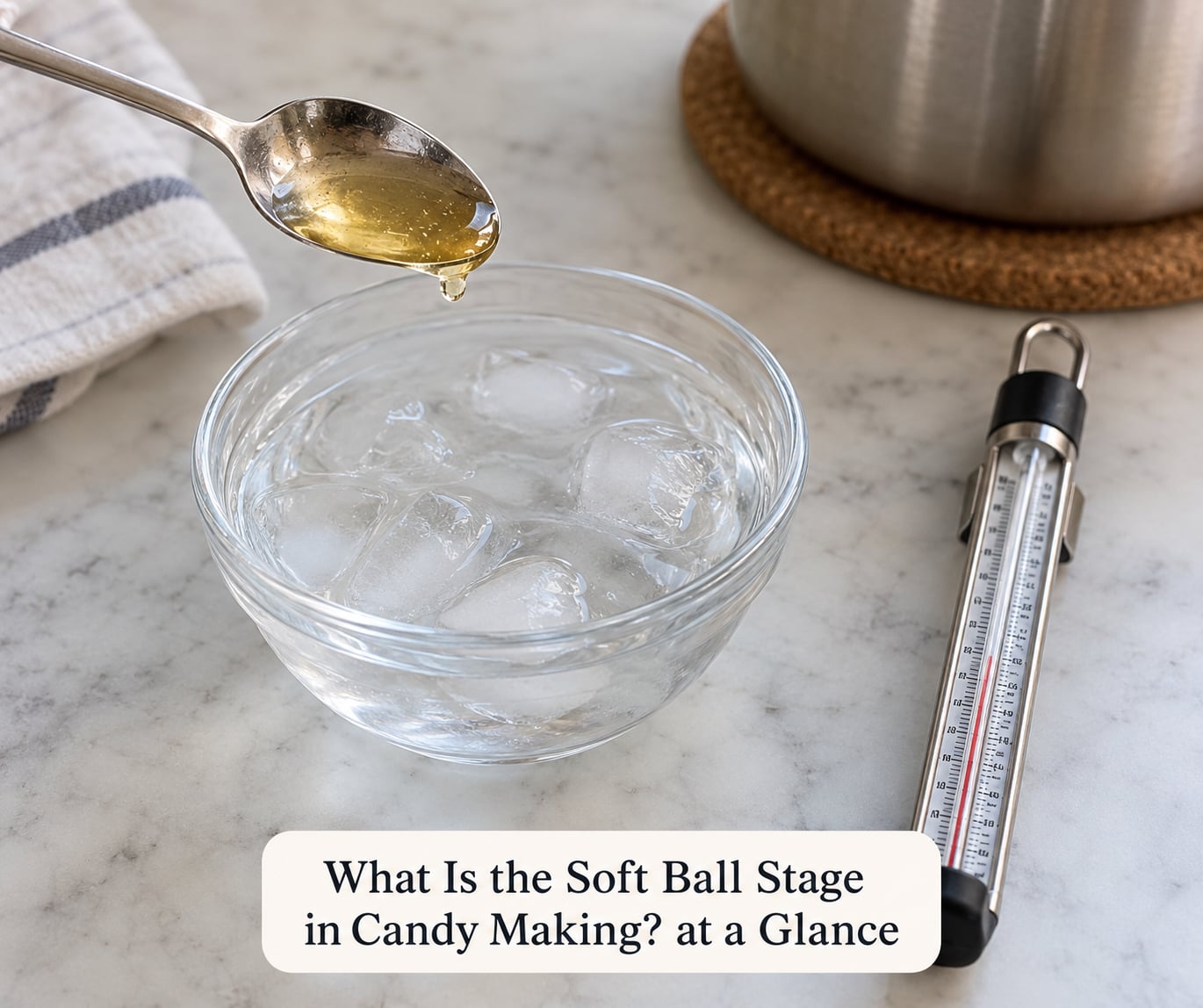
Here is the whole stage map in one place. Ranges overlap a little depending on your recipe and your sugar, so treat them as targets rather than fences.
| Stage | Temperature (°F) | Temperature (°C) | Cold water test result | Typical candies |
|---|---|---|---|---|
| Thread | 230-235 | 110-113 | Syrup falls in fine threads from the spoon | Fruit leather base, syrups, marshmallow base |
| Soft ball | 235-240 | 112-116 | Forms a soft ball that flattens when picked up | Fudge, fondant, pralines, peppermint creams, divanits, soft caramels |
| Firm ball | 245-250 | 118-121 | Forms a firmer ball that keeps its shape | Taffy, pulled candy, firm caramels, some chews |
| Hard ball | 250-265 | 121-129 | Forms a hard ball that dents only under real pressure | Lollipops, toffee, nut brittles, some chews |
| Soft crack | 270-290 | 132-143 | Threads bend without breaking when cooled | Wrapped caramels, toffees, aerated chews |
| Hard crack | 300-310 | 149-154 | Threads snap cleanly and shatter | Rock candy, hard candies, gummies, lollipops, apple candy |
| Light caramel | 320-330 | 160-165 | Deep golden, thin threads when drizzled | Sauces, dipped sweets, blond toffee |
| Dark caramel | 340-350 | 171-177 | Dark brown, nutty, bitter edges | Dark caramel, burnt-sugar flavours |
Most failed batches I have seen were not bad recipes. They were a stage misread, usually fudge cooked into firm ball because the maker trusted the look of the syrup instead of a test.
What Does the Soft Ball Stage Mean?
Sugar does not simply get hot and then suddenly become candy. As a syrup boils, water evaporates, the remaining solution gets more concentrated, and the more concentrated it gets, the hotter it has to be before it will boil again. The temperature reading is really a readout of how much water is left.
By the soft ball stage the syrup is roughly 85% sugar and 15% water. Cooled fast, it has enough structure to hold a shape for a second or two, but it is still plastic rather than firm, so your fingers flatten it. That single behaviour is the whole definition.
The neighbouring stages exist because the same syrup keeps concentrating as the heat climbs. Thread is watery syrup barely holding together. Firm ball and hard ball are progressively firmer and eventually rigid. By soft crack the syrup is so concentrated it stretches instead of flowing, and by hard crack it is glassy enough to snap.
| Test | Soft ball (235-240°F) | Firm ball (245-250°F) | Hard ball (250-265°F) |
|---|---|---|---|
| Cold water drop | Soft ball, slumps | Firm ball, holds briefly | Hard ball, resists a fingertip |
| Finished bite | Chewy, melt-in-the-mouth | Dense chew, pulls away | Very hard chew, tooth-aching |
| Typical use | Fudge, fondant, pralines | Taffy, soft caramels | Lollipops, toffee |
Formulation moves these boundaries. Recipes with corn syrup, glucose, or invert sugar stay softer at the same temperature, and pure cane sugar versus beet sugar can shift things by a degree or two. Your pan matters too, since a heavy cast iron pot climbs differently from thin stainless.
How Do You Recognize the Soft Ball Stage?
What the soft ball stage in candy making looks like in the pan
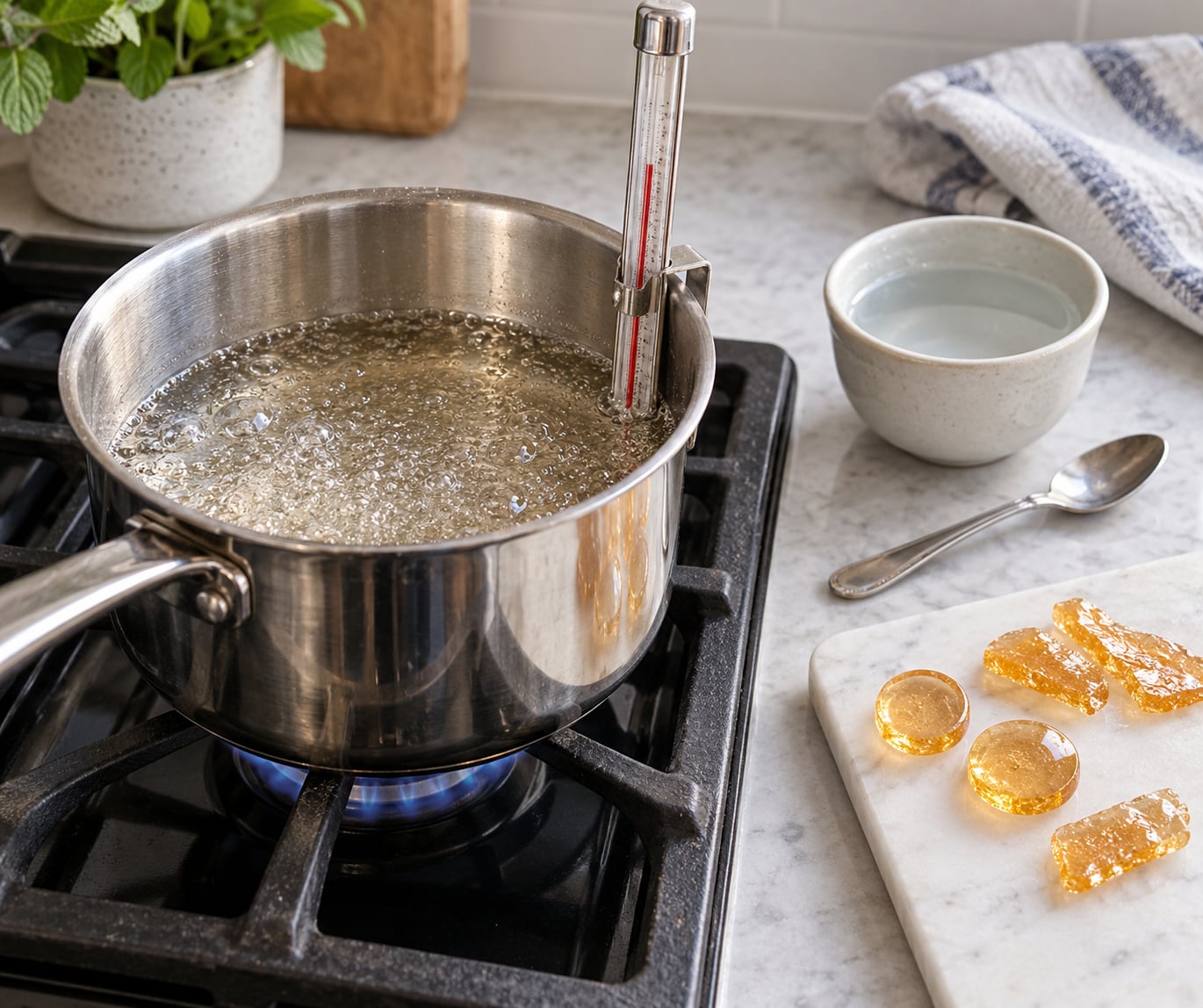
Before the thermometer arrives, watch the bubbles. Early on the boil is a loud, frothy wall of foam. As the syrup concentrates the bubbles shrink, tighten, and turn glossy, and the syrup starts to pull slightly away from the sides of the pan when you tilt it.
Color is a secondary cue only. Clear syrup turning pale gold at soft ball is normal, but syrup color is really about how long you have cooked, not how concentrated it is.
Here is the tactile test that settles it. Scoop a small amount of syrup, about half a teaspoon, and drop it into a cup of cold water. Wait ten to fifteen seconds, then pick it up with clean, dry fingers.
At soft ball it holds together as a soft lump, then flattens into a little pancake the moment you press it. At firm ball it holds a shape and dents slowly. At hard ball it is rigid and has to be broken.
Expect the climb from cold start to soft ball to take somewhere around 15 to 25 minutes on a home stovetop, depending on your pan and how hard you are boiling. A wide, shallow pan gets there quickly because more surface area means faster evaporation. A deep, narrow pot with a gentle flame can take twice as long, which is exactly why a recipe that says “two-hour candy” tells you nothing about temperature.
Most of that time sits in the last ten degrees, right around thread stage, where the syrup is thin enough that heat moves slowly and then suddenly races. If you are watching a clock and it feels stuck, check the thermometer instead of turning the heat up.
A note on the test drop. It is still molten sugar. Never touch it with a fingertip the instant it hits the water, and never try to speed up the cool by stirring the cup. If sugar does hit skin, cool it under running water for at least ten minutes and take it to a doctor, because it stays hot well past the point where it stops looking dangerous.
What to do when the test disagrees with the thermometer
Trust the thermometer first, and the cold water test second, but if the two contradict each other the syrup is telling you your thermometer is off. Re-run the test with a fresh half teaspoon rather than reusing the one that sat in the water too long, because a sample you have fished out and re-warmed will read softer than it should.
Some makers also test twice from the same pot and compare. If the two drops behave differently, the temperature is climbing between samples, and the second reading is the honest one.
How Do You Reach the Soft Ball Stage?
- Prep everything first. Measure the sugar and water, fill a small cup with cold water, and set it beside the stove with a teaspoon on a saucer. Once the syrup is climbing you should not be walking to the sink.
- Dissolve, then stop moving. Bring the sugar and water to a boil, stirring only until clear. After that, leave it alone. Sugar on the wall will crystallize and drop seed crystals into the syrup, which is what makes fudge grainy.
- Wash the sides down. Use a lid or a wet pastry brush to pull stray sugar from the pan walls back into the syrup.
- Clip the thermometer in. Get the tip at least two inches into the syrup without touching the pan bottom, or you will be reading metal temperature instead of sugar.
- Climb slowly and watch. Hold a steady medium-high heat. Rushing the last ten degrees is the single most common way batches go past soft ball.
- Test at 235°F. Drop a small portion into the cold water, wait, and check. If it holds a rigid shape, give it fifteen more seconds.
- Pull the pan off the heat. Residual heat keeps cooking the syrup. Lift the pan rather than turning the burner down to chase a number.
If you finish at firm ball and wanted soft ball, pour warm cream or milk in a thin stream and stir hard while reheating to about 235°F. It will not look pretty, but it rescues a plain fudge batch.
What Temperature Is a Soft Ball Candy?
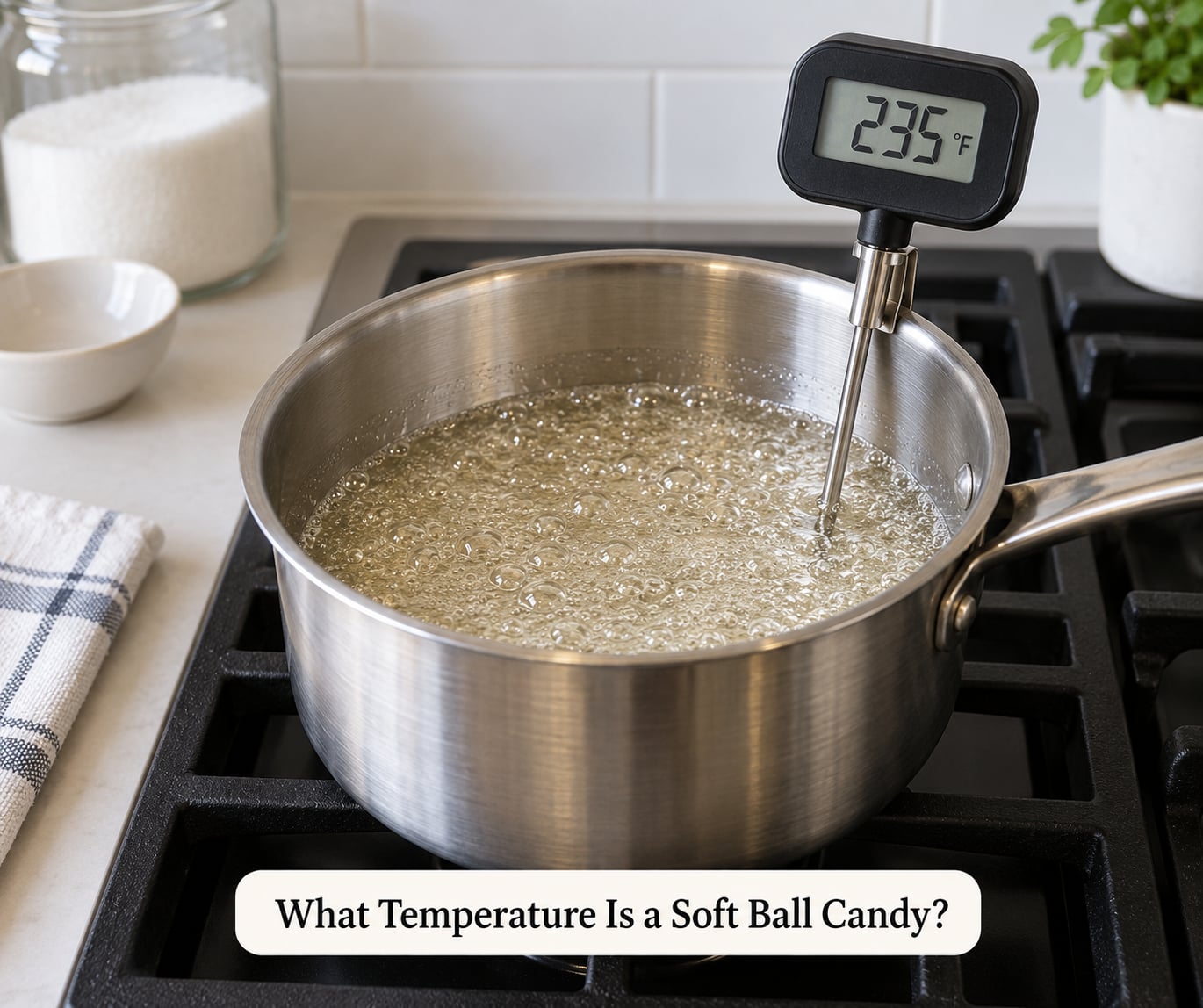
The number to hold in your head is 235-240°F, which is 112-116°C. That covers about 85% sugar concentration and is the range where the cold water test gives you a ball that slumps.
For a quick conversion, subtract 32 from the Fahrenheit number and multiply by five ninths. Anything you read at 238°F lands at about 114°C, which is the middle of the soft ball band.
Two variables shift the target. Above sea level, water boils cooler, so drop roughly 2°F for every 1,000 feet of altitude. At 3,000 feet the soft ball range becomes closer to 232-237°F, which is useful for mountain markets like ours.
On humid days the opposite applies. Above about 60% relative humidity, cook 2-3°F higher, because absorbed moisture makes syrup reach the same consistency at a lower reading.
Calibrate before you trust a reading. Put the thermometer in a pot of rapidly boiling water, stir, and read it once the number settles; a good thermometer sits at 212°F. Cheap models drift by 10°F or more, and uncalibrated thermometers are the most repeated culprit in failed home batches.
What Is the Soft Ball Stage Used to Make?
Soft ball is the workhorse stage for the soft, shape-holding sweets that sell well at a market stall: fudge, fondant, marzipan-style sweets, pralines, peppermint creams, divanits, and the soft end of chewy caramels.
Not everything lands there. Taffy and pulled candy go to firm or hard ball because they need to be pulled without tearing. Rock candy, gummies, apple candy, and most lollipops are hard crack. If a recipe says hard crack and you stop at soft ball, the sugar stays gummy and waxy instead of shattering.
For warm-weather sales, cook soft ball fudge to the upper end of the range, around 238-240°F. It slices cleanly, holds its edge on a tray, and survives a day in a warm car better than a batch stopped at 235°F.
Why Does My Candy Miss the Soft Ball Stage?
The fudge set up too soft
You stopped early, or you pulled at 235°F on the nose. Soft ball is a range, so aim for the middle, and check your thermometer against boiling water before blaming the recipe.
The fudge is rock hard
Overcooking is the usual answer. Syrup that sails past soft ball loses the structure that keeps it chewy, so every extra degree firms up the finished bite.
The fudge is grainy
Crystallization, not temperature. Sugar crystals form on the pan wall, drop into the syrup, and spread through the batch. Cook undisturbed, wash the sides down, and avoid scraping hardened sugar off the pan.
The cold water test felt wrong
Humid days and a cold cup disagree. On a muggy day, test against the dry-texture rule at a slightly higher temperature, and use genuinely cold water every time.
The timing is confusing
Old cookbooks give total boil times, which only work on their stove and their pan size. A wide shallow pan climbs in ten minutes where a deep narrow pot takes half an hour. Watch temperature, not the clock.
How Do You Keep Candy Soft After Cooking?
Work the candy while it is still warm but not hot enough to burn you, then let it cool completely before wrapping. Warm candy wrapped tight traps condensation, and that moisture softens the surface and dulls any sugar coating.
Wrap it properly. Cut blocks in a single layer, wrap tightly in wax paper or plastic, and keep it airtight in a tin. Fudge wrapped this way holds its texture at room temperature for one to two weeks; unrefrigerated and unwrapped, it dries out in days.
For longer storage, freeze it and let it come back to room temperature in the wrapper before opening. Refrigeration is also the right call for very soft, moist creams in summer, though flavours tend to mute after a few weeks cold.
The other half of staying soft is not letting the batch take on water or crystals during the cook. That is why undisturbed boiling and a washed-down pan matter as much as the thermometer.
Frequently Asked Questions
What temperature is the soft ball stage in Fahrenheit?
Soft ball sits at 235-240 degrees Fahrenheit, which is 112-116 degrees Celsius. The syrup is roughly 85% sugar at that point, enough to hold a shape in cold water but still soft enough to flatten under a fingertip. Aim for the middle of the range, around 237-238 degrees, and adjust downward about 2 degrees for every 1,000 feet of altitude.
Is the soft ball test done in cold or boiling water?
Cold water. Boiling water is only used to calibrate the thermometer at 212 degrees Fahrenheit. For the texture test, fill a small cup with cold tap water or ice water and drop in about half a teaspoon of syrup. Wait ten to fifteen seconds, then lift it out with clean, dry fingers and press it. It should slump into a flat pancake.
Can I use a regular kitchen thermometer for candy?
You can, but an instant-read probe is a compromise. Candy syrup climbs fast and holds heat in the pan, so a narrow probe placed two inches deep and left in place tracks the stage better than a quick-read thermometer you wave through the syrup. Read it immediately, because the number drops fast. A dedicated clip-on candy thermometer with a long probe is the tool I trust for repeat batches.
How do I fix candy that went past the soft ball stage?
If it only overshot into firm ball, pour in a thin stream of warm cream or milk while stirring, then bring it back to about 235 degrees Fahrenheit and stir until smooth. Past hard crack, the caramel rescue still works: cool it slightly, add warm cream, and reheat to the soft ball range. Once the batch crystallizes and turns grainy, warmth and agitation will not bring it back.
Does humidity change the soft ball candy temperature?
Yes. Above roughly 60% relative humidity, aim for 2-3 degrees Fahrenheit higher than the usual target, because syrup absorbs moisture from the air and reaches the same texture at a lower reading. Humid days also make the cold water test less reliable, so test a small portion and trust the texture over the number. Dry winter air works the other way and can dry the finished candy out faster.
What to Do First
Set up the cold water cup before you light the stove, and calibrate the thermometer in boiling water so you are reading sugar, not metal.
Then cook to 235°F, drop a small portion into the cold water, and pick it up. If it slumps into a flat pancake, you have your soft ball stage. Shape or pour it right away, because it sets as it cools.