Selling food at a farmers market or public market usually means three separate layers of approval: a vendor permit from the market itself, a business license and food handler certificate from your city or county, and a state-level food permit for whatever you are selling. Add sales tax registration on top. Which state permit applies depends almost entirely on your product.
That last part is where most first-time vendors get stuck. Whole uncut tomatoes you grew and hot sandwiches cooked on a propane griddle sit in completely different regulatory buckets, and the same stall can need four different approvals or none at all. Below is the process I would follow in any county: identify your obligations, classify every item on your menu, then register in the right order.
Rules are set at state, county, and city level, so they change from one market to the next even within a single state. Treat everything below as a working framework, then confirm the specifics with your local health department and the market operator before you buy equipment or sign a booth agreement. Last updated for 2026.
Table of Contents
- What You Need
- Business and seller details
- Your full menu, sorted by category
- Your process for each food
- Equipment inventory
- Supplier and ingredient records
- Proposed booth setup
- Contact details for the local health department
- Step-by-Step: How to Get Approved to Sell at a Market
- Step 1: Identify Your State and Local Requirements
- Step 2: Classify Every Food and Drink You Plan to Sell
- Step 3: Get a Business License and Tax Registration
- Step 4: Apply for Food Vendor or Mobile Food Permits
- Step 5: Schedule Inspections and Plan Safe Food Handling
- Step 6: Get Written Market and Venue Approval
- Step 7: Final Review Before Opening Day
- Common Mistakes
- Assuming produce needs no paperwork
- Preparing food in an unapproved home kitchen
- Forgetting samples
- Treating a business license as a food permit
- Showing up without a handwashing station
- Using a kitchen that is not licensed or not approved
- Underestimating refrigeration
- Changing the menu without telling anyone
- What happens if you sell without a permit
- Frequently Asked Questions
- Do I need a permit to sell fresh produce at a farmers market?
- Can I sell homemade food at a market from my home kitchen?
- What license do I need to offer samples at a public market?
- Do I need a separate food permit for every farmers market?
- Does a business license cover food sales at markets?
- What food insurance and vendor insurance does a market require?
What You Need
You need enough information to answer one question for each item on your menu: who touches this food, where is it prepared, and is it sold ready to eat? Agencies cannot classify your menu for you, and a vague answer is the number one reason an application stalls.
Before contacting anyone, gather the following.
Business and seller details
Your legal name, entity type if you have registered one, federal EIN, mailing address, and a phone number the agency can reach during market season. If you sell under a name that differs from your legal name, note whether you plan to file a fictitious name registration, often called a DBA, in your state.
Your full menu, sorted by category
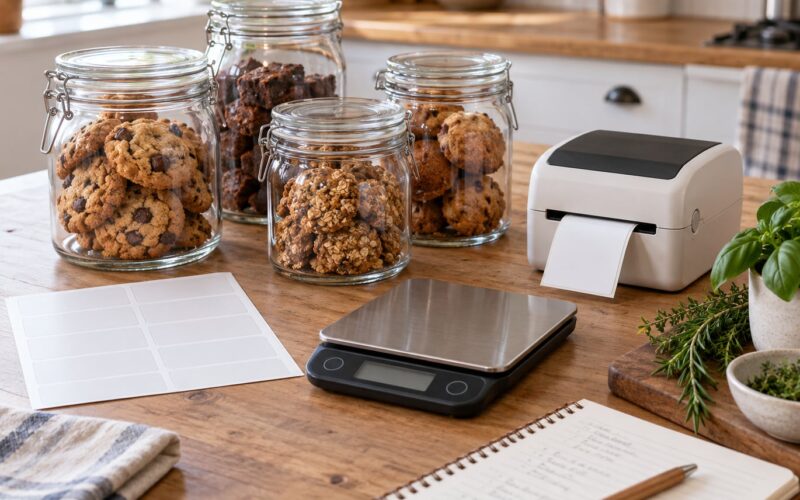
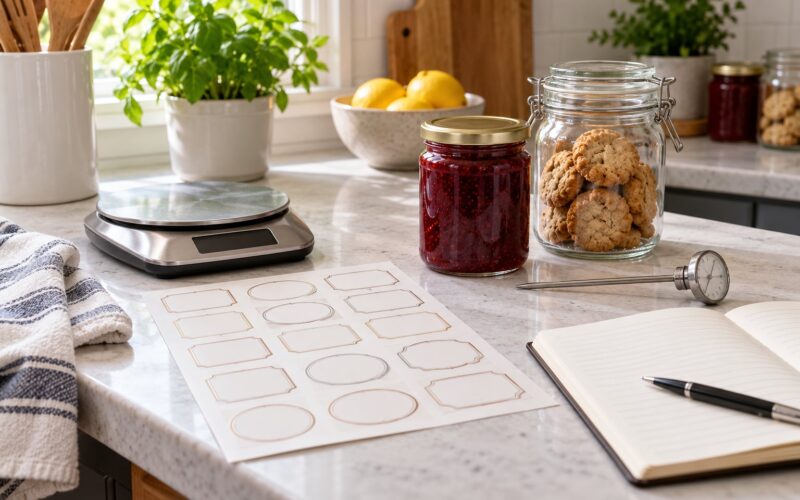
List every single item, not a general description. Write “chocolate chip cookies, made in home kitchen” rather than “baked goods.” Include drinks, condiments, and anything you plan to hand out as a sample, because those are frequently the items that change which permit you need.
Your process for each food
Describe where the food is made, whether it is cooked, reheated, or held at temperature, and whether any cutting, portioning, or assembly happens at the booth. On-site preparation is one of the clearest dividing lines between a light permit and a heavier one.
Equipment inventory
List generators, propane equipment, hot holding units, coolers, refrigerators, sinks, handwashing setups, and thermometer types. Health reviewers want to know whether you bring your own potable water, where grey water goes, and how you keep raw and ready-to-eat food apart.
Supplier and ingredient records
Keep the name and location of every supplier. If you use a licensed commercial kitchen to produce food, you will need that kitchen’s name, permit number, and contact, and most jurisdictions require a written agreement showing the kitchen produces food for you.
Proposed booth setup
A rough floor plan of your stall, showing where cooking equipment sits relative to customers, where waste and water are handled, and how the canopy is secured. Vendors selling anything hot usually have to show separation between the cooking area and the public.
Contact details for the local health department
Most food permits come from a county or city environmental health or public health department, and in some states from the department of agriculture instead. Know which one covers the market’s physical address, not where you live, because the jurisdiction follows the market.
Also settle the variables that decide your path: your state, your city or county, the market’s location, each food category, whether you sell direct to consumers or to restaurants, and whether any cooking happens on site. Five of those six can change your answer.
Step-by-Step: How to Get Approved to Sell at a Market
Approval follows a predictable order, and doing it out of sequence wastes weeks. Start by finding out what you owe, then classify your food, then register your business, then apply for the food permit, then prepare for inspection, then get the market’s written approval, and finally walk through a final review before your first day.
Step 1: Identify Your State and Local Requirements
Your state sets the baseline rules, and your county or city health department is usually the agency that issues the food permit. Start with your state department of agriculture, state health department, and state revenue or taxation office, since each handles a different layer.
Then check the local layer, which is where prepared food is actually regulated. Here is a repeatable process for finding the right office.
- Search your county name plus “environmental health” or “food vendor permit.” County environmental health is the office that issues temporary food establishment and mobile food permits in most states.
- Search your city name plus “special event food permit” or “temporary food facility.” Larger cities often run their own program instead of the county’s.
- Read the market’s own page for the county it operates in, and confirm whether that county handles mobile food units and temporary establishments.
- Call the office and ask one question: “Which permit covers a vendor selling prepared food one day a week at a market on these streets?” The person on the phone will tell you the correct program name in about ten seconds.
One warning here. Do not treat the market organizer’s vendor checklist as your regulatory answer. Managers collect state sales tax numbers, insurance certificates, and stall fees because that is their job, and they are not licensed to interpret health codes. A well-run market will hand you a list, but the list is a starting point, not a substitute for the health department.
Step 2: Classify Every Food and Drink You Plan to Sell

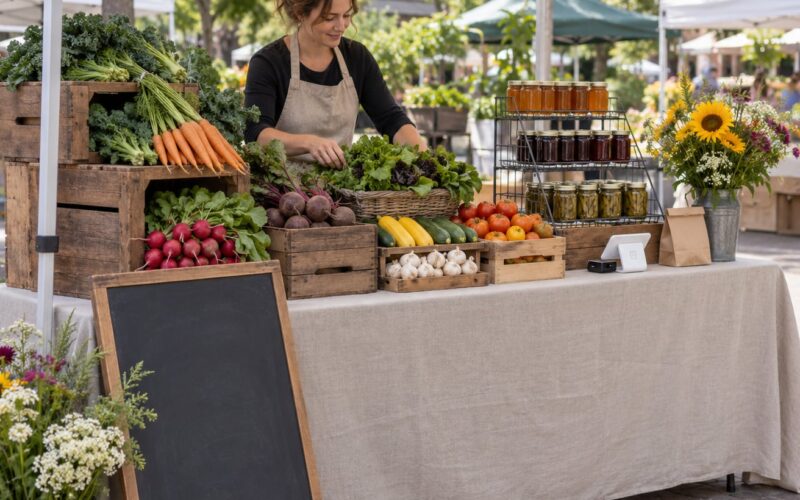
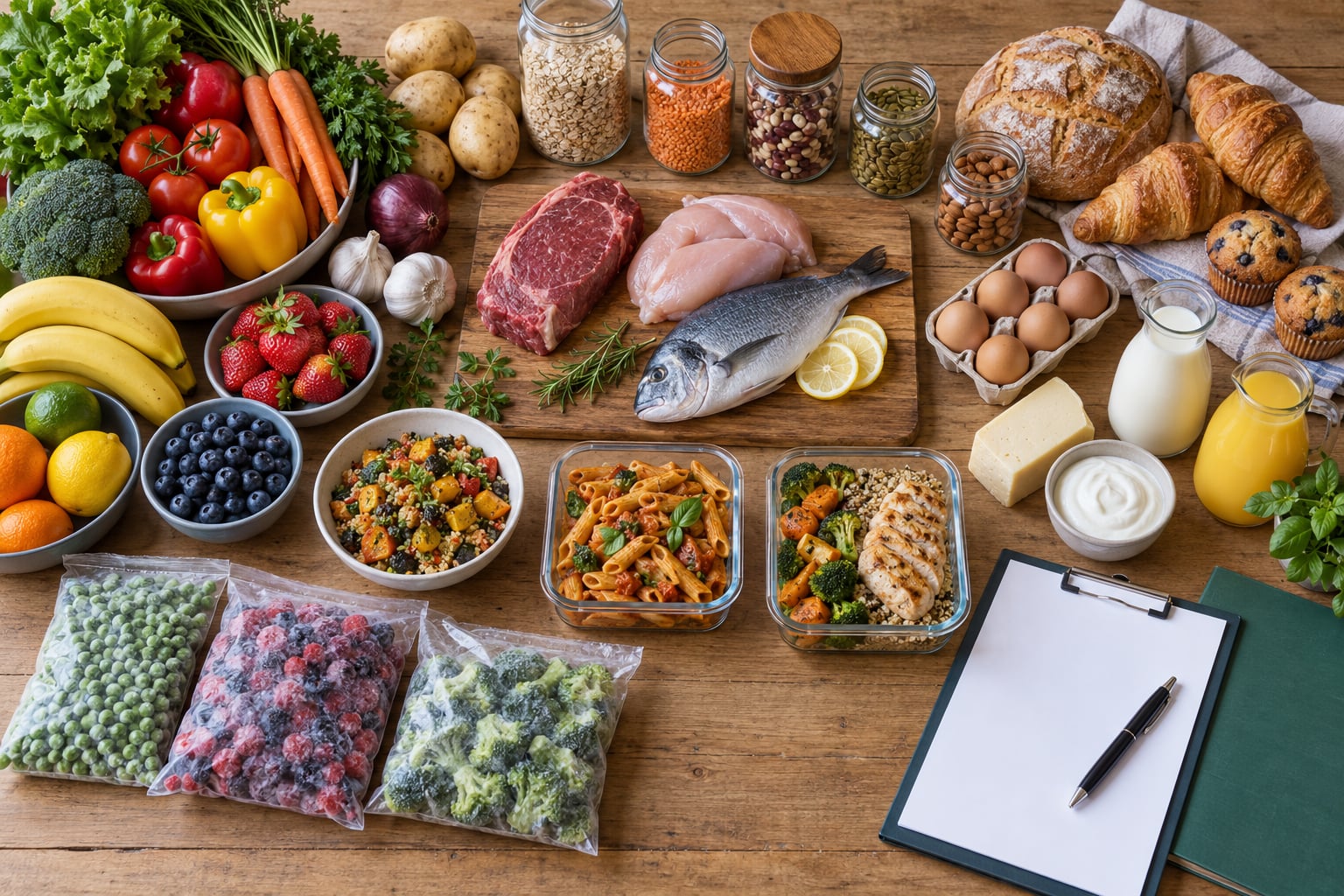
Your permit follows your food, not the other way around. Sort your menu into these groups: whole uncut produce you grew, prepackaged shelf-stable goods you did not make, raw meat and seafood, dairy and eggs, baked goods and other cottage food items, prepared or ready-to-eat meals, samples, frozen items, and beverages.
Two phrases do most of the regulatory work. A potentially hazardous food is a food that can support bacterial growth if handled badly, and a time temperature control for safety food, or TCS food, is a potentially hazardous food that must be held cold or hot to stay safe. Meat, seafood, cut melons, cut leafy greens, cooked rice, eggs, and dairy usually fall in that group. Shelf-stable jams and pickles usually do not.
The table below maps common market products to the permit each one usually triggers.
| What you sell | Permit that usually applies | Who issues it |
|---|---|---|
| Whole uncut fruits and vegetables you grew | Business license; sometimes a certified producer certificate or scaling certificate | City or county business office, state agriculture department |
| Raw agricultural products bought from someone else | Dealer or scaling license in some states | State agriculture department |
| Sealed shelf-stable goods from a distributor | Business license and seller’s permit | City business office, state revenue |
| Home-made baked goods, jams, candies | Cottage food permit or registration, often with an annual sales cap | State agriculture or health department |
| Prepared meals, sandwiches, hot food, cut fruit | Temporary food establishment or mobile food facility permit | County or city environmental health |
| Raw meat, poultry, or seafood | Retail food establishment or mobile food permit plus approved sourcing records | County or city environmental health |
| Anything handed out as a sample | Often a separate sampling approval, sometimes a sampling handler certificate | County or city environmental health |
| Frozen food kept in your own freezer | Storage and temperature controls under the retail or mobile food permit | County or city environmental health |
| Food sold to restaurants, schools, or stores | Wholesale food registration in addition to anything above | State agriculture or health department |
Note the two words in that table: usually. Every state draws these lines slightly differently, and a single state may treat the same product two ways depending on the county. A cut melon, for instance, is whole produce on one side of a line and TCS food on the other side.
Step 3: Get a Business License and Tax Registration
A business license and a seller’s permit cover the money and paperwork side of selling, not the food safety side. You need both, and neither substitutes for the other.
Most vendors need a federal EIN from the IRS, state sales tax registration with a seller’s permit or use tax account, and a resale certificate to buy from distributors without paying sales tax twice. At the local level you register a city or county business license, which is often an annual fee and sometimes includes a gross receipts tax. If you are not operating under your own name in your state, a fictitious name registration, or DBA, may also be required.
Several states treat occasional or intermittent sellers differently from permanent vendors, which can mean a one-time or per-day fee instead of an annual registration. Operating from a vehicle or trailer can also pull you into mobile vendor licensing that a fixed stall does not. Ask your revenue office specifically whether occasional market vendors pay a flat fee, a per-day fee, or a percentage of sales.
Step 4: Apply for Food Vendor or Mobile Food Permits
The application is where your product classification becomes official. Expect to submit a vendor application describing your menu, your preparation sites, and your equipment, plus a plan review fee, a commissary agreement if food is prepared off site, and proof of an approved source for ingredients.
If you prepare food anywhere other than the market, most jurisdictions require that kitchen to be licensed and approved, and this is the item that surprises new vendors most. A commercial kitchen or commissary lets you produce food legally, but you typically have to schedule production there, pay hourly, follow its food safety rules, and in some places report to that facility every time you collect food. An ordinary home kitchen does not qualify unless your state has a cottage food law that covers the specific item, and cottage laws are narrow: they usually cover shelf-stable items like breads, cookies, jams, and candies rather than anything refrigerated.
Ask which credential fits your situation. A temporary food establishment permit covers a booth that assembles or reheats food on site, often for a set market season. A mobile food facility permit covers food prepared in a vehicle or trailer. Seasonal and itinerant credentials exist in many states, and a special event permit can cover a one-day market or holiday pop-up. If you only want to try one weekend, the one-day event permit is usually the fastest route and is the program to ask about first.
Step 5: Schedule Inspections and Plan Safe Food Handling

Inspections usually come after your application is accepted, and they check the setup rather than your food. Have your documentation ready: approved supplier records, your commissary agreement, your commissary’s permit number, and a written plan for each food on the menu.
What an inspector looks at, in rough order: handwashing capability at your stall, potable water and a wastewater plan, sanitizer at the correct concentration using test strips, separation of raw and ready-to-eat food, allergen awareness and labeling, protection from pests and customers, safe water for food contact surfaces, and temperature control.
Know the USDA minimum internal temperatures, because they are the numbers inspectors cite most often. Poultry must reach 165°F, ground meat 160°F, and whole cuts of meat and fish 145°F. Hold cold foods at or below 41°F and hot foods at or above 135°F, and use a calibrated probe thermometer rather than guessing.
Also document your allergen controls. A simple written sheet listing the major allergens in every item, posted where your staff can see it, does more for you than a complicated plan.
Step 6: Get Written Market and Venue Approval
You are subject to two rule sets at once, and passing one says nothing about the other. Government agencies license your food, and the market organization decides whether you may set up a stall on its schedule.
The market side is concrete and deadline-driven. Expect to submit a vendor application by a deadline that can be months before the season starts, pay a stall fee, provide a certificate of insurance naming the market organization as an additional insured, confirm your booth footprint and whether power is available, agree to waste and wastewater disposal, and use only equipment the market approves. Many markets ban open flame under a canopy, forbid propane near public walkways, or require a fire extinguisher and a clear aisle.
Some markets also restrict what you can sell next to whom. You may be barred from selling food that competes with an existing prepared-food vendor, from selling anything that duplicates a neighboring stall, or from selling anything at all if you are not a producer. The market manager can also inspect your booth, and they can require you to leave or cancel your stall for noncompliance.
Step 7: Final Review Before Opening Day
Two or three days before your first market, walk the whole setup once with the checklist below. This is the moment to catch a missing document rather than on opening morning.
- Every permit and license is current, with copies in your booth and the original where the rules require it to be displayed.
- Your business license and seller’s permit numbers match what the market has on file.
- Sales tax is being collected at the correct rate, including any local rate specific to the market’s address.
- Coolers and hot holding units are pre-chilled or preheated, and your thermometer is calibrated and working.
- Every food source is documented and every batch can be traced back to where it was produced.
- Allergen information is written down and posted.
- Handwashing station is stocked with soap, paper towels, and a wastewater container.
- Sanitizer is mixed and test strips are in the kit.
- Your commissary schedule and transport are confirmed, including the pickup time for the market day.
- Your market badge, insurance certificate, and any parking or load-in instructions are printed.
If you change your menu mid-season, contact the issuing agency before you sell the new item. Adding a cooked entrée or a dairy-based product is a different classification, and it may need a permit amendment. Most offices would rather add an item to an existing permit than process a new application, and they will tell you the deadline as long as you ask before you set up.
Common Mistakes
Almost every failed application traces back to one of these. Each has a straightforward fix.
Assuming produce needs no paperwork
Whole uncut produce is usually the lightest category, but not the only one. Selling produce you grew, buying it from another farm, offering cut fruit, or using a certified scale each pull in a different requirement. Pull the exact permit for your exact situation rather than generalizing from what other growers do.
Preparing food in an unapproved home kitchen
Home cooking is fine in your own home. Selling food made in an unlicensed home kitchen is a different activity, and it is the most common reason vendors get shut down mid-market. Use a licensed commercial kitchen or a permitted cottage food operation, or cook entirely on site under your temporary food permit.
Forgetting samples
Many vendors treat sampling as a freebie rather than a food service. Handing out bite-sized portions can trigger a separate sampling approval, a sampling handler certificate, or a requirement that you hold a temporary food permit even when the food itself is cottage food. Ask specifically about sampling before you plan it.
Treating a business license as a food permit
The business license and the seller’s permit are about licensing your operation and collecting tax. They say nothing about whether your food is safe to sell. An inspector will still write a violation at a stall with both documents in hand and no food permit on the wall.
Showing up without a handwashing station
Many markets require a handwashing setup in every food stall, and a bucket with a tap is usually not enough unless the rules accept it. A self-contained handwashing unit with running water, soap, paper towels, and a wastewater container takes a modest outlay and prevents the most common failed inspection item.
Using a kitchen that is not licensed or not approved
Renting a shared kitchen that has no permit, or has a permit that does not cover cottage or wholesale production for other vendors, invalidates everything you do there. Ask the kitchen for its permit number and confirm that its operator allows outside food production.
Underestimating refrigeration
Vendors regularly bring coolers sized for selling, not for holding a full day of TCS food plus ice and drinks. If you cannot hold everything at or below 41°F for the length of the market plus transport, scale the menu down. Running out of safe cold storage gets food thrown out and invites a violation.
Changing the menu without telling anyone
Adding an item that you did not list on your application can invalidate your permit for that item. The fix is a quick email or call to the issuing office, and most agencies will approve it as an amendment if the change is simple.
What happens if you sell without a permit
The consequences escalate rather than disappear. A first visit is usually a written warning or a citation, sometimes with a fine. Repeat violations can bring higher penalties, license suspension, or a stop on your permit renewal. A public market can remove your stall on the spot, ban you from that market, or refuse your renewal for the season, and the health department can take your product or hold it for disposal.
It gets worse from there. If someone becomes ill from your food, operating without a permit can expose you to civil liability, and in some states to criminal charges. It also undermines the certificate of insurance most markets require, which means a single claim could be uncovered. Applying in the off-season is the cheapest insurance in this whole process.
Frequently Asked Questions
Do I need a permit to sell fresh produce at a farmers market?
Whole, uncut fruits and vegetables you grew are usually the lightest category and often need only a business license and a seller’s permit. Requirements change if you buy produce from another farm, cut it at the booth, weigh it on a commercial scale, or prepare it with other ingredients. Some states also issue a certified producer certificate, and a few require a scaling certificate. Ask your county environmental health office about your exact products before your first market, because cut fruit and whole fruit fall on opposite sides of the line.
Can I sell homemade food at a market from my home kitchen?
It depends on the food and your state. Most states have a cottage food law that allows certain shelf-stable items such as breads, cookies, jams, and candies to be made in a home kitchen and sold, usually with registration, food handler training, labeling, and an annual sales cap. Refrigerated or TCS items like cheesecakes, soups, and fresh pasta generally fall outside that exemption. If your item is not covered, you need a licensed commercial kitchen or a temporary food permit with on-site preparation.
What license do I need to offer samples at a public market?
Offering samples usually needs its own approval on top of your food permit. Many counties require a temporary food establishment or mobile food permit specifically for sampling, and some states issue a separate sampling handler certificate that is faster to obtain. Sampling also typically requires an approved handwashing setup, safe handling of utensils between customers, and allergen labeling. The short answer is that a cottage food permit does not automatically cover sampling, so ask your health department about sampling before you plan to offer it.
Do I need a separate food permit for every farmers market?
Usually not, and this is where the structure works in your favor. A seasonal or annual temporary food establishment permit from your county or city health department normally covers you at any market within that jurisdiction for that period. You still need separate written approval from each market organization, plus its stall fee, insurance certificate, and vendor badge. What does not transfer is approval in another county or state, so check every new jurisdiction before you sell there. One-day markets sometimes have their own event permit option.
Does a business license cover food sales at markets?
No. A city or county business license registers your operation and often collects a local business or gross receipts tax. A seller’s permit registers you with your state for sales tax purposes and lets you buy from distributors without paying tax twice. Neither one says anything about food safety, and an inspector can write a violation at a stall that has both documents posted and no food permit. You generally need a business license, a seller’s permit, and a food permit appropriate to what you sell.
What food insurance and vendor insurance does a market require?
Most markets require general liability insurance and ask you to submit a certificate of insurance naming the market organization as an additional insured, often with a minimum coverage amount set by the market. Some also ask for product liability coverage, which protects you if someone claims they became ill from your food. Ask the market for the exact requirements, coverage minimum, and additional insured wording before you buy a policy. Note that having insurance does not replace a food permit, and selling without a permit can undermine your coverage.
Before you buy a single piece of equipment, take your menu to your county or city environmental health office and ask which permit covers it. Then request the market’s vendor application, register your business and sales tax, and apply during the off-season so approval lands before the season starts.