To figure food cost per serving, total the cost of every ingredient in the recipe, then divide that batch cost by the number of servings the batch actually makes. That single division gives you the raw cost of one portion before you add packaging, labor, or a markup.
The math takes about ten minutes for the first recipe and about two once you have a spreadsheet. What trips people up is not the division, it is the yield — whether a batch makes 8 slices or 14, and whether the 2 cups of flour in the recipe actually came out of a bag you paid for once.
Table of Contents
- What You Need
- Step-by-Step: How to Figure Food Cost per Serving
- 1. Define the recipe, yield, and serving size
- 2. List every ingredient and its quantity
- 3. Find the usable cost of each ingredient
- 4. Calculate the total batch cost
- 5. Divide by the number of servings to get your cost per serving
- 6. Add labor, packaging, and overhead when needed
- 7. Check the result before pricing or planning
- Common Mistakes
- Frequently Asked Questions
- How do I calculate the cost per serving of a recipe?
- What is the formula for cost to serve?
- How do I calculate cost per serving when the recipe has no yield?
- Should I include labor in my food cost?
- How much should I charge for baked goods?
- Is there an app or calculator to figure food cost per serving?
- Conclusion
What You Need
You need five things, and four of them are already in your kitchen. The fifth, the yield, is the one most people skip.
- The written recipe, with quantities in cups, ounces, or grams. A recipe you did not write down is a recipe you cannot cost twice.
- Package sizes and the prices you actually paid for each ingredient. Keep the receipt or the delivery invoice; the shelf price is usually not what you paid.
- A kitchen scale, ideally. Weighing the flour beats scooping with a cup, and scooping is where most cost errors hide.
- A calculator and a spreadsheet, or even a sheet of paper with columns for ingredient, quantity, unit cost, and extended cost.
- The finished yield — the number of servings, slices, cookies, jars, or pounds the batch produces after baking, trimming, and cooling.
Optional but useful: an hourly rate for your own time if this is a business, the cost of packaging, and a rough monthly overhead figure such as rent or electricity that you plan to spread across everything you make.
Step-by-Step: How to Figure Food Cost per Serving
Here is the whole method. I will run one batch of 4-ounce chocolate chip cookies all the way through so every number is visible.
1. Define the recipe, yield, and serving size
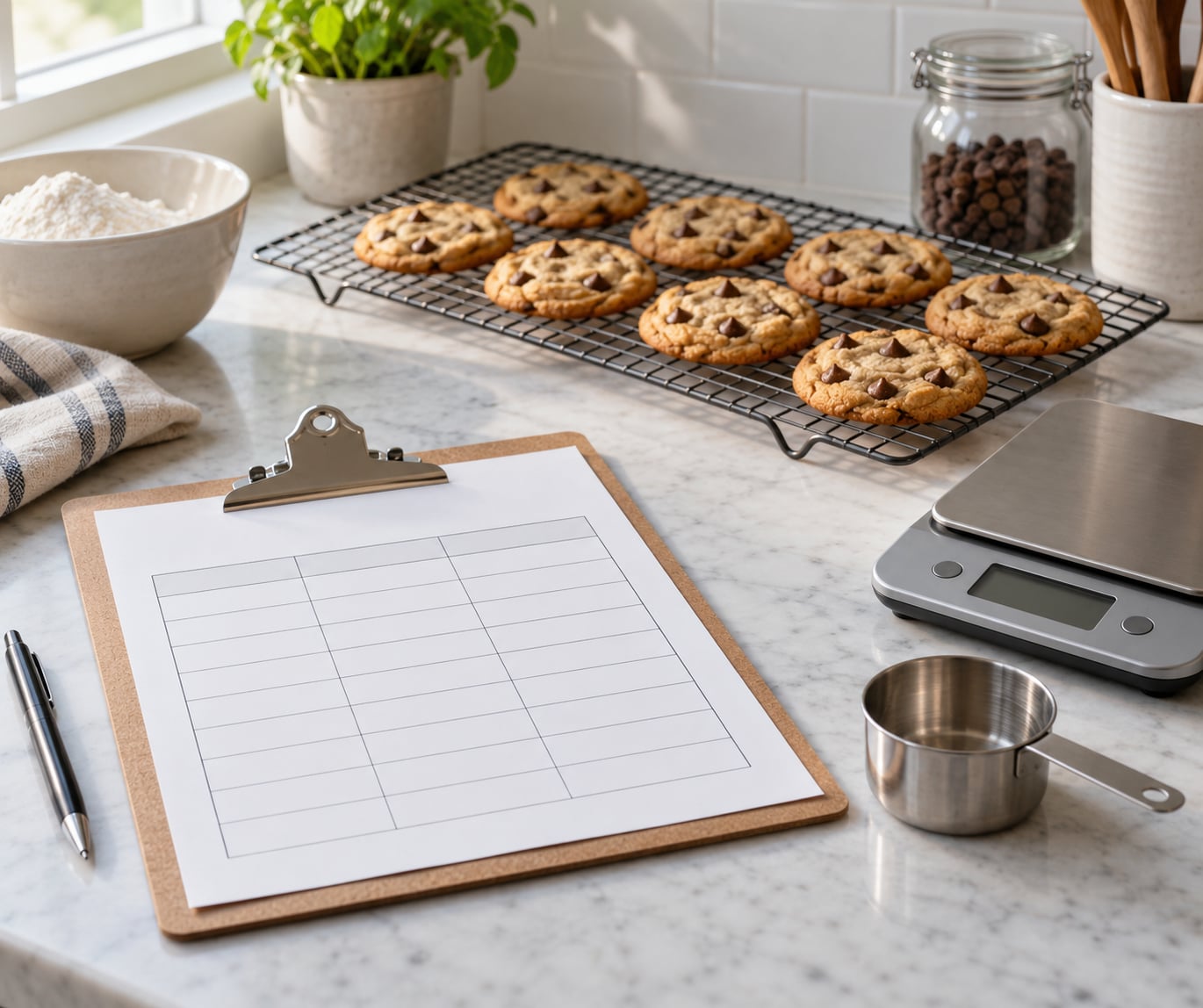
Write down the finished yield before you write down any costs. For our example: one batch of cookies makes 12 cookies, each weighing about 4 ounces after baking.
Count finished portions, not raw weight. Dough that weighs 40 ounces before baking loses moisture in the oven and comes out lighter, so dividing by the raw weight understates the number of servings and inflates the cost of each one. The same applies to soups that thicken as they simmer and to vegetables that trim down before they hit the scale.
Decide now what “one serving” means for this recipe, and write it down. Twelve cookies is twelve servings. A 9-inch round cake cut into eight slices is eight servings. A batch of salsa that fills eight half-pint jars is eight servings.
2. List every ingredient and its quantity
Write a row for every single ingredient, including the small ones. Baking recipes are where people lose the most money, because the baking soda, the vanilla, the salt, and the cooking spray all get skipped.
| Ingredient | Quantity used |
|---|---|
| All-purpose flour | 2 cups (8 oz) |
| Butter | 1 cup (8 oz) |
| Brown sugar | 3/4 cup |
| Granulated sugar | 1/2 cup |
| Eggs | 2 large |
| Vanilla extract | 2 tsp |
| Baking soda | 1 tsp |
| Salt | 1/4 tsp |
| Chocolate chips | 2 cups (12 oz) |
Four ounces of chocolate chips sounds like a rounding error. It is usually the biggest line on the whole sheet.
3. Find the usable cost of each ingredient
For each ingredient, divide the price you paid by how much the package holds. That gives you a unit cost per ounce, per cup, or per item.
Butter is the easy example. A one-pound box costing $5.50 holds 16 ounces, so the unit cost is $0.34 per ounce. The recipe uses 8 ounces, so butter contributes $2.75. Nothing else changes for the rest of the batch — you still have the other half in the fridge.
| Ingredient | Quantity | Unit cost | Extended cost |
|---|---|---|---|
| All-purpose flour | 8 oz | $0.07/oz | $0.56 |
| Butter | 8 oz | $0.34/oz | $2.75 |
| Brown sugar | 6 oz | $0.08/oz | $0.50 |
| Granulated sugar | 4 oz | $0.04/oz | $0.16 |
| Eggs | 2 large | $0.07 each | $0.13 |
| Vanilla extract | 0.5 fl oz | $0.26/fl oz | $0.13 |
| Baking soda | 0.04 oz | $0.48/oz | $0.02 |
| Salt | trace | — | $0.01 |
| Chocolate chips | 12 oz | $0.38/oz | $4.50 |
| Total batch cost | $8.76 |
Two habits make this section faster and more accurate. Buy a kitchen scale and weigh your ingredients in the unit your recipe uses, and record the package price the moment you get home so you are not reconstructing it from memory three weeks later.
4. Calculate the total batch cost
Add the extended cost column. Our batch costs $8.76 to make. That is the total recipe cost, and it is the number every other number comes from.
Do not round yet. Rounding at this stage is how people end up with a batch price that is off by a few cents and never know which row was wrong.
5. Divide by the number of servings to get your cost per serving
Divide the batch cost by the finished yield. $8.76 divided by 12 cookies is $0.73 per cookie. That is your food cost per serving, and it is the floor under your price.
Here are the formulas worth keeping in one place, because most spreadsheet tutorials scatter them across three tabs.
| What you want | Formula | Cookie example |
|---|---|---|
| Total recipe cost | Sum of quantity × unit cost for every ingredient | $8.76 |
| Cost per serving | Total recipe cost ÷ number of servings | $0.73 |
| Cost per dozen | Total recipe cost ÷ number of dozens | $8.76 |
| Cost per pound sold | Purchase price ÷ (1 − trim and shrink rate) | n/a |
| Food cost percentage | (Cost per serving ÷ selling price) × 100 | 18% at $4.00 |
| Fully loaded cost | Ingredients + packaging + labor + overhead share | $1.88 |
| Break-even price | Fully loaded cost ÷ (1 − target food cost %) | $3.42 at a 45% cost target |
Cost per portion is the same number with a different word, so do not go hunting for a second method. Cost per unit is the same idea applied to a dozen, a jar, or a loaf.
Two more quick examples so the method is not cookie-shaped in your head. A 9-inch cake costing $9.21 all in, cut into eight slices, is $1.15 per slice. A pot of soup costing $17.20 that yields ten quart servings is $1.72 a quart. Same division, every time.
6. Add labor, packaging, and overhead when needed
For a home cook, the ingredient-only number is usually the only one you need. For anyone selling, a fully loaded number is a different and more honest figure, because it changes the price you should charge.
Going back to the cookie batch: 45 minutes of hands-on time at $16 an hour adds $12.00, or $1.00 per cookie. A small paper bag adds $0.15 per cookie. Fully loaded, each cookie costs $0.73 + $1.00 + $0.15 = $1.88.
Overhead is different from labor. Rent, utilities, insurance, and equipment are costs of keeping the doors open, and they belong outside your per-serving cost, allocated separately across your whole output. Mixing overhead into food cost is why restaurant cost-per-serving numbers often look confused: food cost percentage is supposed to be ingredients only.
A reasonable food cost percentage target for a small bakery or market stall usually sits between 25% and 35% of sales. Ask your accountant, not a forum, if you are in a regulated situation.
7. Check the result before pricing or planning
Sanity-check three things. The portion should match what you serve: a $0.73 cookie weighed against a 4-ounce scoop should feel right in the hand, and if it does not, your yield was probably wrong. The number should beat a rough guess — if your cookies work out to less per serving than the raw ingredients seemed to weigh, something got dropped from the list.
Then compare it against what similar sellers charge at the same kind of market. Vendors commonly land between three times and nearly four times ingredient cost on baked goods, which puts our cookie at about $2.20 and our fully loaded break-even at $3.42.
Finally, decide how often you will redo it. Ingredient prices drift, and a number you calculated once and never revisited quietly costs you money every week. Recalculate whenever a supplier raises prices, and at minimum twice a year. For market vendors, 2026 is usually a good baseline to reprint your current price sheet from scratch.
Once the sheet exists, reuse it. One spreadsheet with a tab per recipe and a column of ingredient unit costs at the top will cost you five minutes per new recipe after that, instead of an evening.
Common Mistakes
These are the errors that actually move the number, in roughly the order they cause damage.
- Costing by raw weight instead of finished yield. Moisture loss and shrinkage make finished portions fewer than raw weight suggests, so the cost per serving comes out too high. Fix: count the pieces or weigh the finished batch.
- Skipping the small ingredients. Vanilla, salt, leavening, oil, and garnish add up to real money in any baking recipe. Fix: no blanks in the ingredient column.
- Using the shelf price instead of what you paid. Wholesale, co-op, and sale prices are all lower, and using the wrong one makes you overprice or underprice for the wrong reason. Fix: use the invoice.
- Counting the full package every time. If you bake three batches from one bag of flour, the cost is one bag across all three, not one bag per batch. Fix: cost what the batch actually used.
- Folding labor into food cost percentage. It mixes two different things and makes your percentage meaningless for comparison. Fix: keep an ingredient-only number and a separate loaded number.
- Ignoring trim, spillage, and failed batches. Nobody batches at a 100% success rate. Fix: divide by what you actually sell, not what you hoped to sell.
- Setting the price once and never revisiting it. Costs move, and stale sheets are the quietest way to lose margin. Fix: recalculate twice a year.
If a recipe gives no yield at all, make the batch, count the finished portions, and write the number on the recipe. That one habit answers the question permanently, and it is the single most useful thing a market vendor or home baker can add to a recipe card.
Frequently Asked Questions
How do I calculate the cost per serving of a recipe?
Add up the cost of every ingredient in the batch, using the price you actually paid divided by the package size to get a unit cost. Multiply each unit cost by the amount the recipe uses, add those numbers together, then divide the batch total by the number of finished servings the recipe yields. For a batch costing $8.76 that makes 12 cookies, each cookie costs $0.73.
What is the formula for cost to serve?
Cost to serve equals total recipe cost divided by the number of servings, plus packaging, plus any labor you choose to count. Keep the ingredient-only figure separate from the fully loaded one, because food cost percentage is measured on ingredients alone. That way you can compare your numbers against other operations without confusing direct costs with overhead.
How do I calculate cost per serving when the recipe has no yield?
Make the batch once and count what comes out. Weigh the finished food, or count slices, cookies, jars, and portions directly. Write that yield onto the recipe card so it never has to be guessed again. If a batch runs small, note the tray size and oven temperature, since those are usually the reason.
Should I include labor in my food cost?
Keep two numbers. Use ingredients alone when you calculate food cost percentage, which is what bakers and restaurant operators usually compare against a 25% to 35% target. Use a fully loaded number that adds your hourly rate and packaging when you decide what to charge. Your labor still gets paid, just from the markup rather than from the food cost percentage.
How much should I charge for baked goods?
Most home bakers and market vendors start around three times ingredient cost and stretch toward four times once packaging and labor are counted. Our cookie example came to $0.73 in ingredients, which puts the usual starting price near $2.20 and the fully loaded break-even at $3.42. Then compare against what neighbors charge at the same kind of market.
Is there an app or calculator to figure food cost per serving?
A spreadsheet is enough for almost everyone starting out, and a free one costs nothing beyond the setup. Build one tab of ingredient unit costs at the top, then one tab per recipe with quantity, unit cost, extended cost, and servings. Restaurant inventory tools cost real money and are aimed at tracking cost of goods sold across a whole operation, not one dozen cookies.
Conclusion
The whole method is one formula: total recipe cost divided by the number of finished servings. Build the ingredient list with nothing skipped, price each ingredient by what you actually paid for it, divide, and then add labor and packaging as a separate line when you are setting a selling price.
Start tonight with one recipe. Write the yield on the recipe card where you can see it, cost every ingredient down to the vanilla, and divide. One sheet done properly is worth more than a spreadsheet full of half-empty templates, and every batch after that gets faster.