If you are learning how to can peaches in light syrup, the process is simple once you have it down: peel ripe peaches, cut them into halves or slices, pack them into hot jars, and cover them with a thin sugar syrup made from about 2 cups of sugar to 5 to 6 cups of water. The filled jars go into a boiling water bath canner for 25 minutes if they are pints, 30 minutes if they are quarts. It takes 45 minutes for a small batch and closer to two hours for a full seven-quart run, and the actual work is mostly prep.
The word “light” is where most recipes go wrong. Two different ratios get called light syrup, and the difference in sweetness is noticeable once the jars sit on a shelf. I like to make the syrup up in one batch so every jar in the run tastes the same, and I always process the full time even when I’m tired. That processing time is what makes the jar safe.
Table of Contents
- What You Need
- Step-by-Step: How to Can Peaches in Light Syrup
- How to Prepare and Peel the Peaches
- Make the Light Syrup
- Pack and Process the Jars
- Cool, Check Seals, and Store
- Common Mistakes and Helpful Tips
- The syrup is cloudy
- The peaches float when you open the jar
- The skins stayed tough
- The lids did not seal
- The fruit turned dark before packing
- The syrup boiled over or foamed
- Frequently Asked Questions
- Why are my home-canned peaches floating?
- Can I leave the skins on when canning peaches?
- Do I need to add bottled lemon juice to peaches?
- How long should jars of peaches in light syrup be processed?
- Can I use honey or no-added-sugar syrup instead of sugar?
- How should I tell whether a sealed jar has spoiled?
- Conclusion
What You Need

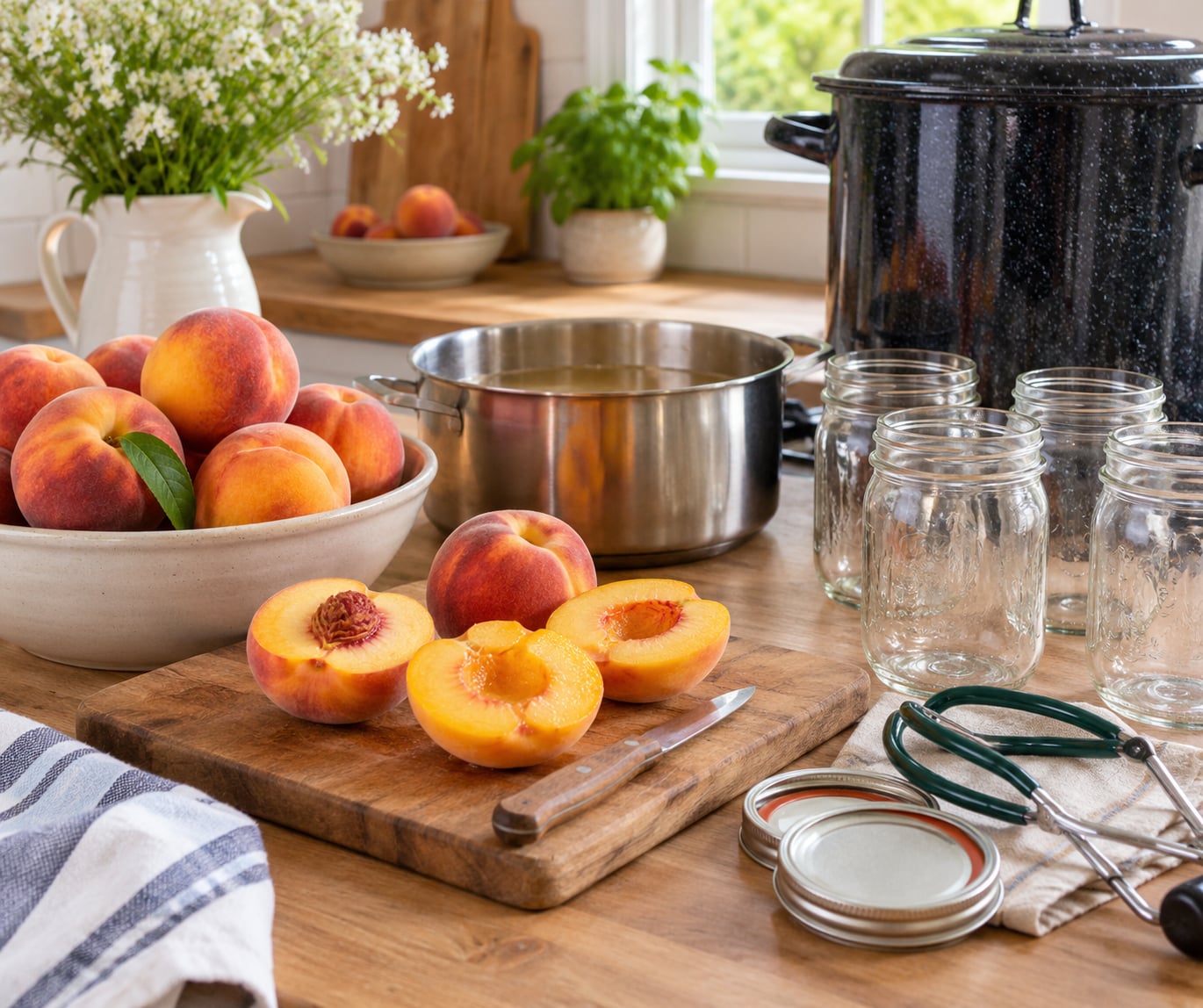
Most of the equipment you need stays in one cupboard for years, so the real cost is fruit and lids. Here’s the full list for a batch that fills about seven quarts or fourteen pints.
- 12 to 14 pounds ripe peaches — freestone varieties peel easily; seconds and tree-ripened fruit work fine
- 2 cups sugar and 5 to 6 cups water — this is light syrup at the ratio used here
- 3 to 4 tablespoons bottled lemon juice — measured into the fruit, not the syrup, so you can adjust for acidity
- 1 to 2 teaspoons ascorbic acid (Fruit Fresh) — optional, if you’d rather not use lemon juice
- Seven quart jars or fourteen pint jars — wide-mouth pints are easier if you want halves rather than slices
- Fourteen two-piece lids (flat lid plus screw band) — bands can be reused, lids cannot
- A water bath canner — a tall stockpot works only if it holds the jars upright with 1 to 2 inches of water above them
- A jar lifter, a funnel, a bubble remover or a clean damp paper towel, and a ladle or small measuring cup for syrup
Wash the empty jars and lids in hot soapy water and set them to simmer in the canner water while you work on the fruit. Lids go in warm water, never boiling, because a lid boiled too hard can fail to seal later.
Budget the time this way: 20 minutes to wash and pit fruit, 15 minutes to blanch and peel, then the hot-packing window where everything has to move fast. Most beginners find one batch of fruit is plenty for a first run.
Step-by-Step: How to Can Peaches in Light Syrup
How to Prepare and Peel the Peaches
Start with fruit that is ripe enough to eat today. Canning does not ripen anything, and underripe peaches stay tough no matter how long you process them.
- Wash the peaches under cool running water and slice them in half around the stone.
- Twist each half in opposite directions to release the pit, then use a paring knife to lift out any remaining stone fragments.
- Set up a pot of boiling water and a second bowl of ice water side by side.
- Blanch the halves 30 to 60 seconds, until the skins slip and the flesh goes soft around the cut edge. You are looking for a slight give, not raw fruit cooking through.
- Move the peaches straight into the ice water for a few minutes to stop the cooking.
- Slip the skins off with your fingers or a paring knife. A spoon works better than a knife for anything that tears easily.
- Cut each half into slices, or leave the halves whole if you are packing them into pints.
Keep cut fruit under cold water with a squeeze of lemon or a spoon of ascorbic acid powder while you work. Air exposure is what turns peaches brown, and ten minutes in lemon water makes a visible difference on a big batch.
Do not can white peaches in a water bath. Their flesh sits closer to neutral in pH than yellow varieties, so a boiling water bath cannot guarantee that spores in the fruit are destroyed. White peaches and any low-acid peach should go into a pressure canner using a tested recipe or be frozen, eaten fresh, or dried instead.
Make the Light Syrup
Light syrup at the ratio used in this guide is 2 cups of sugar to 5 to 6 cups of water. That gives roughly a cup and a half of syrup per jar, which is enough to cover the fruit and still leave the finished peaches tasting like fruit rather than candy.
If you have ever grabbed the wrong can at the store, this is the cheat sheet. The four standard styles, sugar to water:
- Extra light syrup — 1 cup sugar to 3 cups water. Closest to fresh fruit, very mild.
- Light syrup — 2 cups sugar to 5 to 6 cups water. Sweet enough for pie, gentle enough for breakfast. This is the one used throughout this guide.
- Medium syrup — 1 cup sugar to 1 cup water. The classic canned-peach sweetness.
- Heavy syrup — 1 cup sugar to 2/3 cup water. Syrup-forward, and it holds color best.
Add bottled lemon juice to the fruit rather than to the syrup, because each batch of peaches has its own acidity. Use 1 tablespoon per quart of fruit or 1 teaspoon per pint. Bottled lemon juice has a standardized acidity, which is why tested canning recipes call for it and why a squeeze of a fresh lemon is not a substitute.
Combine the sugar and water in a saucepan and bring to a full rolling boil. For hot packing, reduce it until it thickens slightly so it pours rather than runs; for a raw pack, keep it at a full boil right up to the moment you ladle it. Have it waiting, steaming, before you start packing.
Pack and Process the Jars
Fill a sink or a large bowl with hot water and heat the empty jars in it so they arrive at the packing bench still hot. Everything from here runs fast.
- Drain the hot jars. Fill each one with prepared peaches, cutting the fruit to fit so you are not forcing pieces into the jar.
- Add the lemon juice, measuring it into each jar rather than mixing it into the whole batch.
- Pour the boiling syrup over the fruit, leaving 1/2 inch of headspace for pints and quarts. Measure with a ruler once; you’ll get a feel for it fast.
- Run a non-metallic utensil or a clean damp paper towel around the inside rim to pull out trapped air bubbles and wipe away syrup or fruit.
- Place a hot flat lid on the jar and screw the band on until it is fingertip tight. Not gorilla tight. Excess torque bends the rim and ruins the seal.
- Fill the water bath canner with hot water, bring it to a boil, and lower the jars in with the jar lifter.
- Keep the water 1 to 2 inches above the jar lids. Add boiling water if the level drops.
- Start the timer when the water returns to a full boil. Process pints for 25 minutes and quarts for 30 minutes at sea level.
- Turn off the heat and let the canner sit 5 to 10 minutes before lifting the jars out.
If you live above 1,000 feet, the boiling point drops and the fruit needs longer in the canner. Add the extra time to the base time, not instead of it:
- 0 to 1,000 feet — no added time for either pints or quarts.
- 1,001 to 3,000 feet — add 5 minutes to pints and 5 minutes to quarts.
- 3,001 to 7,000 feet — add 10 minutes to pints and 10 minutes to quarts.
- 7,001 to 10,000 feet — add 15 minutes to pints and 15 minutes to quarts.
Yes, a boiling water bath is enough for peaches, and no, you do not need a pressure canner for yellow peaches — the added lemon juice acidifies them enough for the water bath to be safe. The processing time is not adjustable on your own. Under-processing leaves air and bacteria inside the jar, and home canning guidance from the National Center for Home Food Preservation and USDA is built on tested times for a reason. Do not shorten the boil because the fruit looks done; it is sealed safety, not texture, that the clock measures.
Cool, Check Seals, and Store
Lift the jars out and set them on a towel or a cooling rack, right-side up, with space between them. Leave them alone for 12 to 24 hours without touching them. Jars are often tested too early, and pressing a lid before the glass has fully cooled can still look sealed because the fruit and liquid are hot.
After the jars have fully cooled, press the center of each flat lid with a fingertip. A sealed lid does not flex, click, or pop back up; it feels tight and gives you nothing. Some lids still show a small dent of the pattern in the metal, and that is normal. A lid that moves means the seal failed.
If a jar did not seal, refrigerate it and use the peaches within a week, or put the jar in a pot of boiling water and reprocess it for the full time again with a new lid. Anything that is still loose after that goes in the trash.
Store sealed jars in a cool, dark, dry place away from the stove, with the bands left on. Properly sealed peaches keep about 12 to 18 months, and both the syrup and the fruit grow darker as they sit. That color change is storage, not spoilage.
Common Mistakes and Helpful Tips

Almost every disappointing jar traces back to one of six things. Each fix below names the cause first, because knowing why makes it far less likely the second time.
The syrup is cloudy
Cloudy syrup usually means fruit juice escaped into the syrup, which is normal and harmless. It more often shows up when you fill jars too full, so pieces get pushed down and break under the syrup. Pack loosely, leave the headspace measurement alone, and wipe the rim clean every time.
Extra tip: keep the peeled fruit in lemon water rather than plain water. Fruit sitting in plain water dilutes flavor and speeds up browning, and it gives you cloudy syrup to match.
The peaches float when you open the jar
Floating fruit means air is trapped in the piece itself, not around it. That happens when raw-packed fruit expands during processing. Raw packing gives you a brighter color and a firmer texture, but hot packing is the direct fix for floating pieces and gives you a fuller jar.
Extra tip: weigh the fruit down. Lay a small piece of clean canning weight on top of the peaches in each jar before the syrup goes in, and remove it before sealing. Small tomato canning weights work well for slices in pints.
The skins stayed tough
Tough skins come from blanching too briefly or too cool. Thirty to 60 seconds in actively boiling water is the target, and the skin should visibly wrinkle at the cut edge before you move the fruit to the ice bath.
Extra tip: don’t peel fruit before it cools. Warm flesh tears under a knife, and tearing leads to broken pieces and mushy texture in the finished jar.
The lids did not seal
A failed seal usually traces to a rim with syrup or food on it, a lid from an old batch, or a band screwed down too hard. Wipe the rim with a clean dry towel, use a fresh two-piece lid every time, and tighten to fingertip pressure only.
Extra tip: check the flat lid for a visible rim of rust or a warped edge before it ever goes near a jar. A bent lid will not seal no matter how carefully you process it.
The fruit turned dark before packing
Oxidation does this, and it happens faster than most beginners expect in a full sink of prepped fruit. Hold cut peaches in cold lemon water or an ascorbic acid solution, work in smaller batches, and keep the whole prep window under about two hours.
Extra tip: rinse the treated fruit briefly under cold water before packing. Leftover lemon juice in the jar is sharp, and a quick rinse removes it without undoing the anti-browning work.
The syrup boiled over or foamed
Sugar foams when it hits a small amount of water and heat too fast. Use a wider pan, stir until the sugar dissolves before the boil gets going, and keep the heat at a steady medium rather than blasting it on high.
Extra tip: reduce the syrup slightly for hot packing. A thinner syrup pours into gaps between the fruit instead of sitting on top, which means better coverage and fewer floating pieces.
Frequently Asked Questions
Why are my home-canned peaches floating?
Floating fruit means air is trapped inside the peach pieces, which usually happens when fruit is raw packed and expands during processing. The fix is hot packing: boil the fruit briefly in the syrup before it goes into the jar, so the pieces shrink and release their air. You can also weigh the fruit down with a clean canning weight before adding syrup. Floating fruit on its own is not a safety problem, but crowded pieces leave less fruit per jar.
Can I leave the skins on when canning peaches?
You can, and many canners do it for a softer, more pie-ready texture. Skin-on fruit is packed raw with syrup poured over it, and the skin slows softening during processing. Be aware that skins wrinkle as the fruit ages, which some people like and others find unpleasant, and that raw-packed fruit takes longer to reach a soft texture. Peaches packed with skins take slightly longer in the water bath than peeled, hot-packed fruit.
Do I need to add bottled lemon juice to peaches?
Yes, tested peach canning recipes call for bottled lemon juice added to the fruit. Yellow peaches are a low-acid fruit, and the added acid is what makes a boiling water bath safe for them instead of requiring a pressure canner. Measure 1 tablespoon per quart of fruit or 1 teaspoon per pint. Use bottled juice rather than fresh because its acidity is standardized, and follow the amount in your tested recipe rather than tasting as you go.
How long should jars of peaches in light syrup be processed?
At sea level, process pints for 25 minutes and quarts for 30 minutes in a boiling water bath. Above 1,000 feet, add 5 minutes; above 3,000 feet, add 10 minutes; above 7,000 feet, add 15 minutes. Start the timer only after the water returns to a full rolling boil. These times come from tested USDA and National Center for Home Food Preservation guidance, and shortening them can leave a jar improperly sealed or unsafe to store.
Can I use honey or no-added-sugar syrup instead of sugar?
You can replace some or all of the sugar with honey, though honey is not as sweet and the finished jars will be less sweet, so many canners use a mixture. A water pack with no added sugar is also possible and is a common choice for peaches, which are naturally sweet. Sugar does more than sweeten: it affects fruit texture and color, so no-sugar packs stay firmer and lighter. Follow a tested recipe for whichever route you choose.
How should I tell whether a sealed jar has spoiled?
Before opening, press the center of the flat lid. It should not flex, click, or pop back up. Set the jar on a counter for 12 to 24 hours and check that nothing leaked. When you open it, discard the jar if the lid was loose, if liquid is spurting or fizzing, if the contents look moldy, discolored with an odd color, or smell yeasty or fermented. Never taste food you suspect has spoiled.
Conclusion
Start by setting out tested fruit, clean jars, fresh lids, and a working water bath canner before you cut a single peach. Everything after that is steady work: peel, pack, fill the headspace, and run the full processing time without shortening it.
Accurate processing, an honest seal check after 12 to 24 hours of undisturbed cooling, and cool dark storage are what turn this into food you can count on next winter. Presentation is a bonus. A perfectly sealed jar of slightly imperfect peaches beats a pretty one that did not seal every time.