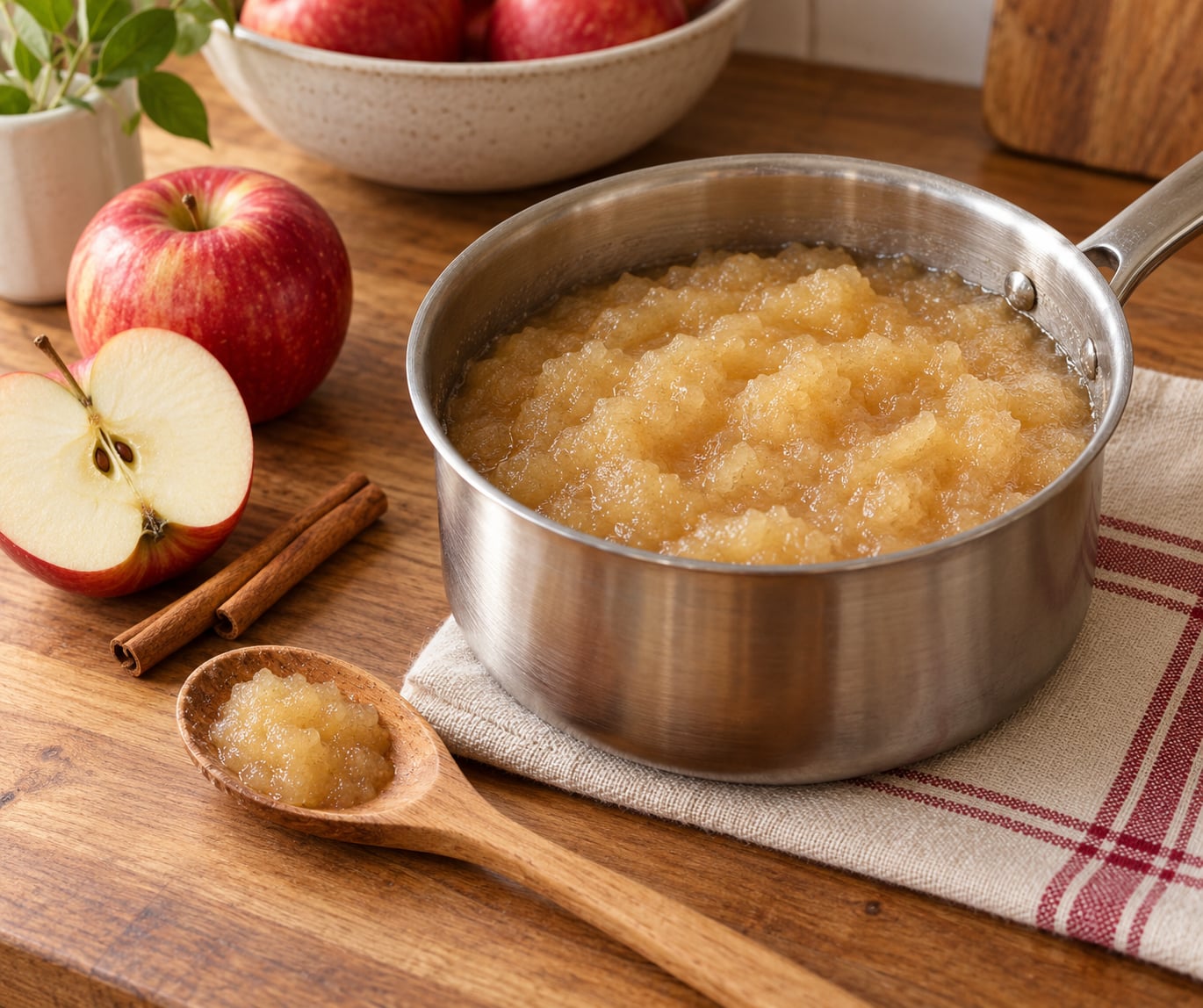
To make applesauce without added sugar, cook ripe apples slowly with a splash of water until they break down, then mash or blend them. The sweetness comes from the fruit itself, so variety matters more than technique. Start with sweet apples such as Fuji, Gala or Honeycrisp, add a little lemon juice and cinnamon, and let a gentle simmer do the rest.
The whole thing takes about 35 minutes start to finish, and the hardest part is picking fruit that is already ripe. No blender is required, though a masher and a saucepan will get you a rustic sauce in minutes.
Table of Contents
- What You Need to Make Applesauce Without Added Sugar
- Which apples work best when you cannot add sugar
- Should you peel the apples
- Step-by-Step
- 1. Choose and prepare the apples
- 2. Cook the apples until tender
- 3. Choose the applesauce texture
- 4. Adjust the flavor and consistency
- 5. Cool and store the applesauce
- Cool it fast, then refrigerate
- Freeze it in single portions
- Canning no-sugar applesauce safely
- Common Mistakes
- Watery applesauce
- Mushy applesauce
- Bitter applesauce
- Bland or still-tart applesauce
- Two tips worth keeping
- Frequently Asked Questions
- What are the best apples to use when making applesauce without added sugar?
- How can I make applesauce smoother without adding sugar or thickeners?
- Why does my applesauce taste sour after I remove all the added sugar?
- How long does homemade no-sugar applesauce stay fresh in the refrigerator?
- Can I safely water-bath can applesauce that contains no added sugar?
- Can I make applesauce without added sugar in a slow cooker?
- Conclusion
What You Need to Make Applesauce Without Added Sugar
You need very little. A heavy saucepan or Dutch oven, a wooden spoon, and whatever you have for mashing will do the job. For four servings, three to four pounds of apples is the right amount, and about half a cup of water keeps everything from scorching.
Here is the base list:
- 3 to 4 pounds apples, a mix of sweet and tart varieties
- Half a cup water, or unsweetened apple juice or cold cider
- 1 tablespoon lemon juice, optional
- 1 cinnamon stick or half a teaspoon ground cinnamon, optional
- A small pinch of salt, optional
The single most important decision happens before you turn on the heat. No-sugar applesauce has nothing to round out the sharp edge of a tart apple, so lean on fruit that is naturally sweet and mix in one tart apple for balance rather than cooking sweet apples alone.
Which apples work best when you cannot add sugar
Ripe sweet apples carry roughly 10 to 13 grams of natural sugar per 100 grams, while sharper varieties sit closer to 8 to 10. Those few grams are the whole recipe, so it is worth knowing which apple is doing the work in your pot.
| Variety | Flavor profile | Natural sugars per 100g (approx.) | Role in the pot |
|---|---|---|---|
| Fuji | Very sweet, floral, juicy | 12 to 13 g | Base, carries the batch |
| Gala | Sweet, mild, crisp | 10 to 11 g | Base, softens quickly |
| Golden Delicious | Sweet, buttery, tender | 10 to 11 g | Base, thickens the sauce |
| Honeycrisp | Sweet, crisp, floral | 11 to 12 g | Base, holds its shape |
| Jonagold | Sweet-tart, aromatic | 10 to 11 g | Works as a half-and-half blend |
| McIntosh | Tart, soft, jammy | 11 to 12 g | Thickens well, needs a sweet partner |
| Granny Smith | Sharp, firm, bracing | 8 to 10 g | One apple only, for contrast |
| Braeburn | Sweet with a spicy edge | 11 to 12 g | Base, stands up to spices |
My default mix is two Fuji or Gala apples to every one Granny Smith. That ratio gives you a sauce that tastes like apples instead of a bowl of sweet puree, and it still reads as mild enough for a toddler.
Should you peel the apples
You do not have to. Leaving the peel on keeps most of the fiber in the sauce and thickens it naturally as the pectin softens, which matters when you have no sugar or starch to lean on. The color will be a deeper gold and the texture a bit more rustic.
Peel when you want a pale, silky puree, when serving to a baby under a year old, or when the skins are thick and waxy, as they are on late-season Granny Smith. Coring is always worth doing, because the seeds are bitter.
Step-by-Step
1. Choose and prepare the apples

Rinse every apple under cold water, core out the seeds, and cut each one into even chunks about the size of a walnut. Even pieces matter more than size, because they soften at the same rate instead of leaving half the pot as watery bits.
Leave the skins on unless you have a reason not to. Rough chop is fine; a food processor will turn the fruit to mush before it hits the heat.
2. Cook the apples until tender
Put the apples in a heavy pot with the water or cider and the lemon juice. Bring to a boil over medium-high heat, then turn the heat down until you see a lazy bubble every second or two.
Cover and simmer for 15 to 25 minutes, stirring now and then so nothing catches on the bottom. The apples are done when a spoon slides into a piece with no resistance, and the liquid has reduced to roughly a third of its starting volume. That reduction is where the flavor concentrates.
If you see white foam, skim it off. It is mostly apple proteins and it will make the finished sauce taste flat if you leave it in.
3. Choose the applesauce texture
How you break the fruit down is entirely up to you, and this is where the recipe splits into four different dishes.
- Rustic chunky: mash with a potato masher, leaving most pieces intact. This is the texture most people mean when they say homemade applesauce.
- Smooth: use an immersion blender right in the pot. Twenty seconds of work, no transfer, no mess.
- Ultra-smooth: push the cooked fruit through a food mill or blend it. Silky enough to spoon into yogurt.
- Coarse textured: pulse in a food processor in two or three short bursts, stopping before it turns to purée.
If you plan to blend in a countertop blender, cool the fruit first. Hot fruit releases steam that will pop the lid off and throw scalding sauce across your kitchen. Let it sit for 15 minutes or work in small batches.
4. Adjust the flavor and consistency

Taste the sauce before you put anything else in it. Warm fruit tastes milder than it will cold, so taste it again once it has cooled to decide if it needs help.
A pinch of salt sharpens the apple flavor more than any amount of sugar would. After that, work in small amounts:
- A squeeze of lemon juice if it tastes flat rather than tart
- Half a teaspoon ground cinnamon, or a cinnamon stick added during the simmer
- A teaspoon of vanilla extract stirred in at the end
- A tablespoon of unsweetened apple cider for a thinner sauce
- A spoonful of unsweetened dried cranberries or raisins, simmered in the last five minutes
- Freshly grated nutmeg, allspice, or pumpkin pie spice, used sparingly
On texture: if the sauce is loose, simmer it uncovered for another five to ten minutes until it coats the back of a spoon. If it is too thick, loosen with hot water a tablespoon at a time. You cannot add moisture back into fruit that has already broken down, so thickening always means reducing, never stirring in more.
One warning about the common sweetener swaps: honey, maple syrup, and date paste all add sugar, so they disqualify the batch as no-sugar. They are worth reaching for only when you are cooking for a child who refuses tart fruit and a swap is the difference between them eating it and not.
5. Cool and store the applesauce
Fresh no-sugar applesauce keeps well because apples are naturally acidic, but you still need to cool it properly and store it clean. Treat it like any cooked fruit you intend to eat cold.
Cool it fast, then refrigerate
Transfer the sauce to a shallow container so heat escapes quickly, and refrigerate uncovered for the first hour. Once it is cold, seal it and move it to the back of the fridge where it will sit at a steady temperature.
Plan on four to five days in the refrigerator for the most defensible window. A splash of apple cider vinegar stirred into the finished sauce can stretch that by a day or two, and keeping the container scrupulously clean matters more than the seasoning. Discard it if it fizzes when opened or smells fermented.
Freeze it in single portions
Freezing is where no-sugar applesauce really earns its keep, because it holds up for months with nothing added to keep it. Leave a finger of headspace in each container, since the sauce firms up as it chills.
For babies and toddlers, freeze single spoonfuls in an ice cube tray and transfer the frozen blocks to a bag once solid. Thaw one cube overnight in the fridge. For adults, half-cup portions in a flat container stack neatly in the freezer and thaw in about two hours on the counter.
Canning no-sugar applesauce safely
This is the question most home canners search for, and the honest answer is that you can do it, with the right process. Canning communities consistently report that apples carry enough natural acid for water-bath canning, and that sugar in traditional recipes acts mainly as a flavor and texture agent rather than as the safety mechanism. That said, do not improvise a processing time.
Follow a tested recipe from a source such as the National Center for Home Food Preservation, and use the processing time it specifies. Adding lemon juice or citric acid is part of most tested no-sugar recipes for a reason, so keep it in unless the recipe says otherwise. If your apples are unusually sweet, you can reduce the water you use, but never skip or shorten the boil.
What you cannot do is improvise a recipe from a blog post that never mentions processing times. Botulism is not something you can taste or see, and a jar that looks fine can still be unsafe. Follow the tested method end to end, including headspace, jar size, and cooling time.
Common Mistakes
Almost every disappointing bowl of no-sugar applesauce traces back to one of four things. Here is what went wrong and what to do about it.
Watery applesauce
The fix is reduction. Put the sauce back over medium heat without a lid and simmer it until steam is rising steadily and the surface has stopped looking glossy and wet. Expect another 5 to 15 minutes depending on how much liquid escaped.
Next time, cut the added water down to a quarter cup or use less, cover the pot for most of the cook, and choose a softer variety such as McIntosh or Golden Delicious that breaks down on its own.
Mushy applesauce
Overcooked fruit loses its aroma and turns to paste, and with no sugar to hold the texture there is nothing to disguise it. Watch the pot more closely than you think you need to, and pull the apples as soon as a spoon goes through without resistance.
Using firmer apples such as Honeycrisp, Fuji, or Braeburn helps. A pressure cooker or Instant Pot gives you more control here than a stovetop pot, because the fruit cooks fast in a closed environment rather than scorching dry against the bottom.
Bitter applesauce
Bitter applesauce nearly always means seeds got crushed into the batch. Core the apples fully and scrape out the seed clusters before cooking, because those contain amygdalin, which turns bitter when broken.
If it is already bitter, a small amount of lemon juice will not save it. Start a new batch.
Bland or still-tart applesauce
Tartness in a no-sugar batch is an apple selection problem, not a seasoning problem. Mix in sweeter fruit next time, and cook a little longer at a gentle simmer, since slow reduction rounds off sharpness.
For the batch in front of you, a cinnamon stick, a splash of vanilla, or a pinch of salt will shift the perception more than any amount of sweetener. Serving it slightly warm also tastes sweeter than the same sauce served cold.
Two tips worth keeping
Save the cooking liquid. The water you simmered the apples in is lightly flavored with cinnamon and apple, and it makes good oatmeal or a thin glaze for pancakes the next morning.
In baking, unsweetened applesauce works as a straight swap for the same volume of oil, and about a quarter cup replaces one egg in muffins and quick breads. It brings moisture and pectin, so your baked goods stay tender.
Frequently Asked Questions
What are the best apples to use when making applesauce without added sugar?
Fuji, Gala, Golden Delicious, Honeycrisp, and Braeburn all carry enough natural sugar to make a sweet sauce on their own. The trick is balance: combine two sweet apples for every one tart apple such as Granny Smith. McIntosh is worth using for its pectin, which thickens the sauce, but pair it with something sweeter because on its own it makes a sharp jam. Always cook fruit at room temperature or slightly warm, since cold apples dilute your cooking liquid and take longer to soften.
How can I make applesauce smoother without adding sugar or thickeners?
You do not need a thickener at all. Push the cooked apples through a food mill for a fine, seed-free texture, or use an immersion blender in the pot for a quick smooth result. If you are using a countertop blender, cool the fruit first, because hot apples build steam that can blow the lid off. Longer, slower cooking also does the work for you: the pectin in the skins breaks down as the fruit simmers, and unpeeled apples will thicken the sauce on their own.
Why does my applesauce taste sour after I remove all the added sugar?
Because sugar was doing more than making things sweet, and unripe or tart apples have not supplied enough of their own. The usual fix is a better apple mix rather than more seasoning: two sweet apples to one tart apple instead of all Granny Smith. Simmering longer at a gentle heat reduces the sauce and softens the sharp edge. A pinch of salt, a cinnamon stick, and a squeeze of lemon juice will round it out, though too much lemon makes a tart sauce even sharper.
How long does homemade no-sugar applesauce stay fresh in the refrigerator?
Four to five days is the number I trust, and it assumes you cooled the sauce quickly, used a clean container, and kept it cold the whole time. Apples are naturally acidic, which helps, and a splash of apple cider vinegar stirred in at the end can buy you another day or two. If a jar fizzes when you open it or smells like alcohol, discard it without tasting. For anything beyond a week, freeze it in single-serve portions rather than relying on the fridge.
Can I safely water-bath can applesauce that contains no added sugar?
Yes, but only with a tested recipe and a full processing time. Apples are naturally acidic enough for water-bath canning, and sugar in traditional recipes mainly handles flavor and texture rather than acting as the preservative. Use a recipe from a tested source such as the National Center for Home Food Preservation, keep the lemon juice or citric acid it calls for, and never shorten the boil to save time. Botulism cannot be tasted or seen, so a jar that looks and smells fine is not proof that it is safe.
Can I make applesauce without added sugar in a slow cooker?
Yes, and the slow cooker is arguably the easiest way to get a smooth result. Add roughly four pounds of chopped apples, half a cup of water or cider, and a cinnamon stick, then cook on high for about three hours or on low for six to seven until the fruit collapses into a mash. Because the heat is gentle and constant, the sauce reduces naturally and tastes rounder than a quick stovetop batch. Leave the lid cracked for the last half hour if you want it thicker.
Conclusion
Start with the fruit. Two sweet apples to every tart one, peeled or unpeeled depending on how smooth you want the result, simmered gently with a splash of water and a little lemon juice until a spoon slides through without resistance. That is the whole method, and once you have it, texture and seasoning are just adjustments you make at the end.
Mash for a rustic sauce, blend for a smooth one, and reduce it a little longer whenever it looks thinner than you want. Once you know how to make applesauce without added sugar, you will stop reaching for the jar on the shelf.